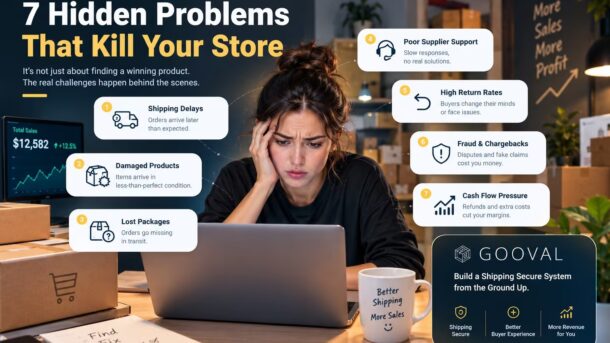
Every dropshipping store operator knows the feeling: you find a winning product, your ads start converting, and then the wheels come off in a way you never planned for. The problems that sink most stores are not the ones visible on the storefront — they are the operational failures happening behind the scenes. Below are the seven issues that virtually every dropshipping store encounters at some point, along with practical ways to address them — including how platforms like Gooval are helping operators build shipping secure systems from the ground up.
1. Supplier Reliability Collapses Under Pressure
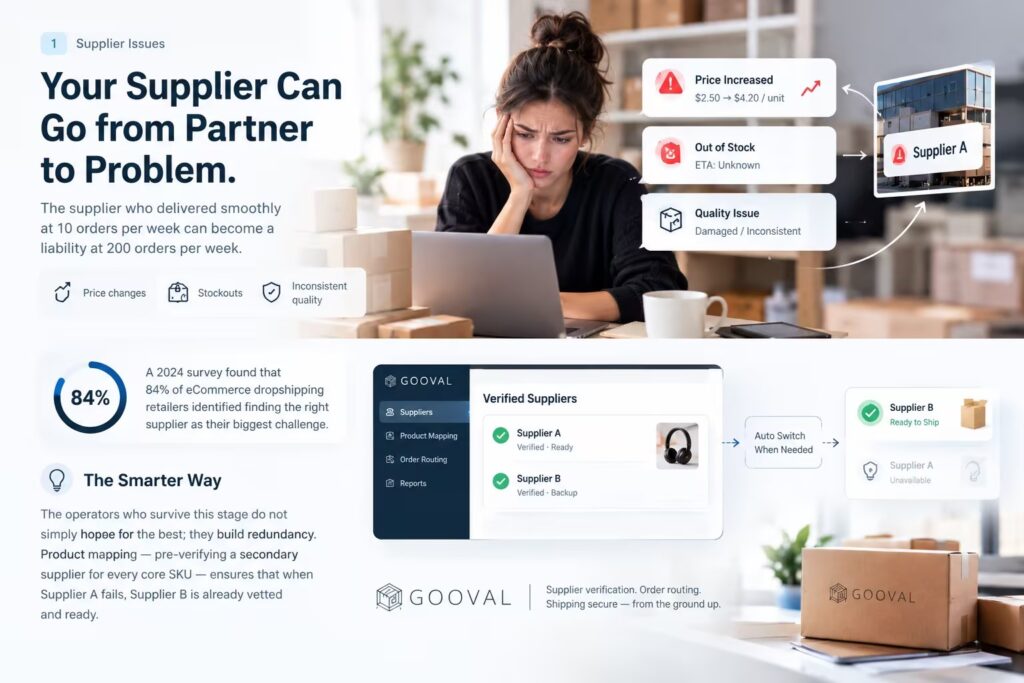
The supplier who delivered smoothly at 10 orders per week can become a liability at 200 orders per week. Price changes, stockouts, and inconsistent product quality are not exceptions — they are the norm. A 2024 survey found that 84% of eCommerce dropshipping retailers identified finding the right supplier as their biggest challenge. The operators who survive this stage do not simply hope for the best; they build redundancy. Product mapping — pre-verifying a secondary supplier for every core SKU — ensures that when Supplier A fails, Supplier B is already vetted and ready. Gooval streamlines this process by centralizing supplier verification and order routing, so shipping secure starts with knowing exactly who is packing your orders — and having a verified backup when they cannot.
2. Shipping Times Destroy Customer Trust Before the Product Arrives
You spend $500 on ads, drive 20 customers to your store, and then discover the product is out of stock at the factory. This is not just lost revenue — it damages your ad account score and payment gateway reputation. The root cause is a gap between what your storefront says is available and what the supplier actually has. Manual checks cannot solve this; by the time you check, the stock situation has already changed. Real-time inventory synchronization via API is the only reliable fix. When a SKU hits zero at the supplier, your “Buy Now” button should disable automatically. Gooval connects directly to supplier systems and syncs inventory across your storefront and every connected marketplace in real time, so overselling becomes a problem of the past. This is not a premium feature — it is a baseline requirement for secure operations.
3. Inventory Desynchronization Silently Kills Margins
You spend $500 on ads, drive 20 customers to your store, and then discover the product is out of stock at the factory. This is not just lost revenue — it damages your ad account score and payment gateway reputation. The root cause is a gap between what your storefront says is available and what the supplier actually has. Manual checks cannot solve this; by the time you check, the stock situation has already changed. Real-time inventory synchronization via API is the only reliable fix. When a SKU hits zero at the supplier, your “Buy Now” button should disable automatically. Gooval connects directly to supplier systems and syncs inventory across your storefront and every connected marketplace in real time, so overselling becomes a problem of the past. This is not a premium feature — it is a baseline requirement for secure operations.
4. Returns and Disputes Erode Profit from the Inside
Every dropshipper hits the same wall: a customer wants a refund, but the product is sitting on another continent, and the return freight costs more than the item is worth. Dropshipping stores are still charged shipping fees by suppliers, and those costs come directly out of margins unless they are priced in correctly. The answer is not to avoid returns — it is to make the front end so clear that returns become rare. Accurate sizing guides, unedited product videos, and explicit quality disclosures reduce the mismatch between expectation and reality. And when a return is genuinely warranted, a fast, no-argument resolution builds more long-term value than a disputed $20. Gooval helps operators document every order touchpoint, so when a dispute does arise, you have the evidence to resolve it quickly — and the data to prevent the next one.
5. Ad Costs Rise While Margins Stay Flat
Customer acquisition costs on Meta and Google have roughly doubled in three years. Operations that worked at $30 CAC do not work at $60. Most dropshipping stores respond by cutting prices to stay competitive, which compresses margins further and creates a race to the bottom. The stores that survive this pressure shift their focus from acquisition volume to customer lifetime value. Email flows, SMS retention, and a genuine post-purchase experience turn a one-time buyer into a repeat customer. When the same customer buys three times, the effective CAC drops by two-thirds. Secure shipping is not just about the package — it is about securing the relationship that produces the second and third order. Gooval supports this shift by making post-purchase communication and delivery visibility a native part of your operations, not an afterthought.
6. Single-Channel Dependence Makes the Business Fragile
Account suspensions, ad platform algorithm changes, and shipping disruptions can wipe out a single-channel operation overnight. The dropshipping stores that scaled in 2026 are the ones that stopped treating their storefront as the only channel. Diversification across marketplaces, email lists, and even offline touchpoints creates a buffer that absorbs platform shocks. This is not about spreading thin — it is about ensuring that no single decision by a platform you do not control can end your business. Gooval acts as a central operations layer across channels, so your inventory, orders, and shipping data stay consistent no matter where the sale happens.
7. The Operational Complexity Compounds Until Something Breaks
The layer most dropshippers underestimate is inventory synchronization across multiple channels. Even though physical stock is held by suppliers, real-time accuracy across your storefront and every connected marketplace is mission-critical. Stacking too many plugins without a coherent architecture creates conflicts that manifest as overselling, duplicate charges, and fulfillment errors. The stores that scale treat their stack as an architecture, not a collection of apps. Every tool must have a defined job, and every data flow must have an owner. Gooval is built for exactly this: a single, coherent layer that replaces plugin sprawl with unified inventory, order, and shipping logic — so your operations stay secure as volume grows.
The dropshipping market is projected to reach $1.35 trillion by 2031, growing at over 21% annually. The opportunity is real. But the operators who capture it are not the ones who chase trends — they are the ones who build operational discipline into every layer of the store. Shipping secure is not a feature you add at checkout. It is the cumulative result of supplier verification, real-time data, transparent communication, and a stack that does not break when volume increases. Gooval exists to make that standard accessible to every dropshipping store — not as an insurance policy, but as the operational backbone that keeps shipping secure at scale.