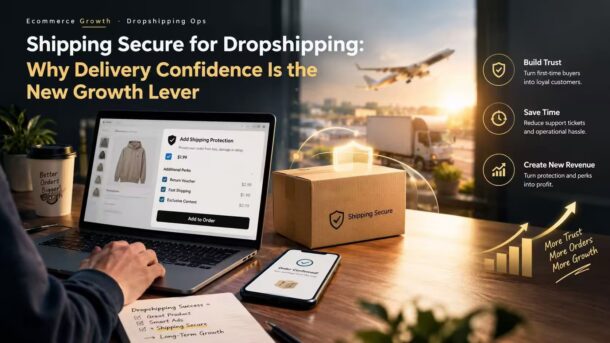
Most dropshipping advice starts and ends with traffic: find a winning product, scale the ad, rinse, repeat. But growth doesn’t stop at checkout. With Shipping Secure, merchants can protect the post-purchase experience and preserve customer trust — because winning the click means little if a missing package costs you the customer.
For dropshipping stores, shipping security is more than risk management. Combined with customizable buyer perks and optional merchant markups, it can help reduce after-sales pressure while creating new revenue opportunities. Here’s why Shipping Secure deserves a place in your growth strategy.
The Post-Purchase Problem Nobody Markets
The genius of dropshipping is also its blind spot: you never touch the product. Goods move straight from a third-party warehouse — often overseas — to your customer’s door. You own the brand, the ads, and the relationship. You do not own the box in transit.
That separation is liberating until it isn’t. When a parcel is lost, stuck in customs, shattered in transit, or snatched from a porch, the customer doesn’t message the fulfillment center. They message you. And for a solo founder or a two-person team, those “where is my order?” threads, payment disputes, and chargeback threats quietly consume the hours you should be spending on growth.
The real cost of unreliable delivery isn’t the refund. It’s the founder time and customer trust you bleed out while trying to fix it.
Notice this isn’t a logistics failure so much as a growth tax — a recurring fee you pay in attention every single week.
What “Shipping Secure” Actually Means
Before we go further, a precise definition, because the term gets muddled:
Shipping secure is a checkout add-on that secures a customer’s delivery against common transit problems — loss, damage, and theft — by routing resolution through a dedicated secure provider instead of your own support team.
Two things matter here:
- It is a delivery-security layer, not a policy document. Customers opt in at payment; if something goes wrong in transit, they file with the secure provider, and the provider handles the outcome.
- It sits between the warehouse and the doorstep. It secures the journey, not the product itself.
That distinction is the whole game. You’re not buying coverage for everything under the sun — you’re securing the one part of the experience you can’t personally control.
Why Dropshipping Stores Need It More Than Anyone
A traditional retailer can walk into their back room and inspect a shipment. A dropshipping store has no back room. Your fulfillment is delegated, which means your delivery confidence has to be delegated too.
Shipping secure is, in effect, the control you rent over a supply chain you don’t own. And in a marketplace crowded with look-alike stores, that confidence is your moat: shoppers can’t tell your sourcing from a competitor’s, but they can absolutely feel whether buying from you feels safe.
Three Growth Levers (Not Just Risk Avoidance)
Here’s the reframe most guides miss. Shipping secure doesn’t only prevent losses — it actively creates upside.
1. Trust → Higher Conversion
A visible “your delivery is secure” signal reduces cart anxiety, especially on cross-border or higher-ticket orders where buyers hesitate to trust an unfamiliar store. When the checkout tells a customer their parcel is secured end-to-end, the psychological friction of clicking “Pay” drops. That’s conversion-rate optimization you didn’t have to A/B test.
2. Time → Real Focus
Offloading transit claims to a dedicated secure provider empties your support queue overnight. The hours you used to spend chasing carriers now go to sourcing, creative testing, and CRO — the work that actually scales a store.
3. Margin → A New Revenue Line
Providers like Gooval share a portion of the secure fee back with the merchant as a kickback. Because you’re not carrying the risk or handling the claims yourself, that rebate lands on your books as pure net profit — not revenue offset by support labor or refund reserves. What was once pure logistics overhead becomes a quiet, high-margin income stream attached to orders you were already shipping.
How It Works at Checkout
The mechanism is deliberately simple:
- Integrate a secure widget into your store (most platforms drop in via plugin or API).
- Surface the option at the payment step, alongside shipping choices.
- Relax — when a transit issue occurs, the customer resolves it with the secure provider, not your team.
You stay entirely out of the crossfire.
The Fintech Engine Behind the Promise
A fair question: how can a platform like Gooval confidently promise to absorb delivery issues at scale? The answer is infrastructure, not guesswork.
Gooval is, at its core, a fintech company. To stand behind high-volume fulfillment commitments, it has secured its own product’s fulfillment capacity with international A-rated insurance institutions. In practice, that means each valid problematic order is ultimately covered at the institutional level — the underwriter backs the resolution, so the promise you make to customers is underwritten by real balance-sheet capacity rather than hope.
That backing is what lets a shipping secure service operate as a true delivery-security layer instead of a vague assurance. Behind the single checkout toggle sits a stack of automated risk pricing, real-time claim routing, and carrier-grade settlement — the same machinery a fintech uses to move money reliably. To the merchant, none of that complexity shows up; what you experience is simply: deliveries are secure, and issues get resolved fast.
Set Healthy Boundaries
Shipping secure is powerful, but it isn’t a cure-all — and pretending otherwise hurts stores. Be clear with yourself and your customers about scope:
- It secures the transit journey: loss, damage, and theft between warehouse and doorstep.
- It does not cover manufacturing defects, wrong variants, or product-quality complaints.
The honest play: pair airtight delivery security with disciplined supplier vetting. Secure the trip; earn the trust; let product quality do the rest.
Implementation Notes for Store Owners
If you run the store, setup is lighter than you’d expect:
- Platform fit: Solutions like Gooval.io integrate with mainstream carts (Shopify, WooCommerce, and similar) through plugins or APIs.
- Timeline: Most stores are live in an afternoon, no custom dev required.
- Placement tip: Surface the secure option near the shipping estimator and again on the order-confirmation page — two moments where delivery confidence directly shapes behavior.
Frequently Asked Questions
A shipping secure service is a checkout add-on that secures a customer’s delivery against common transit problems — loss, damage, and theft — by routing resolution through a dedicated secure provider instead of your own support team.
No. Shipping secure is a delivery-security service layered into checkout; it is not an insurance policy you buy. Behind the scenes, established providers do secure their own fulfillment capacity with A-rated institutions — but to you and your customer it simply appears as a secure delivery, not a formal policy.
Usually the opposite. A clear “delivery secured” signal reduces buyer anxiety and can lift completion rates, particularly on cross-border or higher-value orders.
No. Your supplier remains accountable for product quality and accurate fulfillment. Shipping secure covers what happens after the item leaves the warehouse — the transit itself.
Providers like Gooval return a portion of the secure fee to the merchant as a kickback — pure net profit on orders you were already shipping, with no risk or claims handled by you.
Providers like Gooval are fintech companies that secure their own fulfillment capacity with international A-rated insurance institutions. Each valid problematic order is ultimately backed at the institutional level, so the merchant’s “delivery secured” promise is underwritten by real capacity rather than assumption.
The Bottom Line
Dropshipping rewards founders who remove friction between a shopper and a purchase. Most of that energy goes into the ad and the landing page. The sharper move is to secure the delivery, too — because a store that consistently gets parcels to doorsteps, stress-free, is a store customers come back to.
Shipping secure won’t source your products or write your ads. But it will hand you back your time, harden your customer trust, and quietly add margin — three things every scaling dropshipping store is short on.