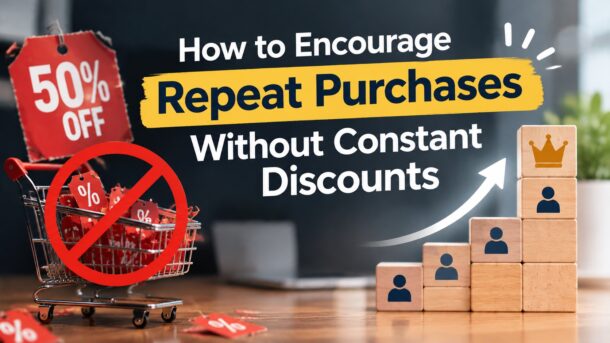
For many independent ecommerce stores, encouraging repeat purchases is just as important as acquiring new customers. While discounts can bring shoppers back, relying on constant promotions may train customers to wait for the next deal rather than buy at full price. A more sustainable approach is to build customer loyalty through better shopping experiences, relevant benefits, useful post-purchase communication, and products that give customers a genuine reason to return.
For Shopify merchants and other direct-to-consumer (DTC) brands, the goal is not simply to get customers to place another order. It is to make the next purchase worthwhile without sacrificing profit margins to constant discounts.
Here are six practical strategies to encourage repeat purchases, strengthen customer relationships, and build a more sustainable ecommerce business.
1. Understand Why Customers Do Not Make Repeat Purchases
Before launching a loyalty program or sending another promotional email, find out why customers are not coming back.
The answer is not always price. Some customers may be satisfied with their first purchase but have no immediate need for another product. Others may have experienced unclear shipping updates, a complicated return process, or disappointing customer support.
Segment Customers by Purchase Behavior
Start by reviewing your customer and order data. Group customers into a few practical segments:
- First-time buyers: Customers who have placed one order but have not purchased again.
- Repeat customers: Customers who have completed two or more purchases.
- High-value customers: Customers who contribute meaningful revenue or profit over time.
- Inactive customers: Customers who have not purchased within a period that makes sense for your product category.
Then look for patterns. Which products generate the most repeat purchases? How long does it typically take customers to place a second order? Do customers who contact support return less often?
Identify the Real Barriers to Returning
Shopify’s guide to customer retention strategies explains how merchants can use customer segmentation, retention metrics, and targeted communication to better understand existing customers.
The key is to identify the problem before choosing an incentive. A customer who needs product education may not need a coupon. A customer who experienced a frustrating order issue may need a clear resolution before considering another purchase.
2. Give Customers Reasons to Return Beyond Discounts
A discount creates a financial incentive, but it does not automatically build a lasting relationship with a brand.
Instead of asking which discount will persuade someone to buy again, consider what additional value your store can provide.
Offer Benefits That Match Customer Needs
Depending on your products and customers, useful benefits might include:
- Relevant product recommendations: Suggest complementary products based on previous purchases.
- Product education: Share care instructions, tutorials, and practical tips that help customers get more from their purchases.
- Early access: Give returning customers advance access to new products or selected collections.
- Exclusive content: Offer guides, inspiration, or other resources that are genuinely useful.
- Shopping convenience: Make reordering easier with clear product information and straightforward customer accounts.
- Customer perks: Offer benefits such as free shipping on eligible orders, loyalty rewards, or vouchers for future purchases.
The right benefit depends on the business model. A skincare store might send a product-use guide and a replenishment reminder. A home decor brand could recommend complementary items. A specialty coffee store might remind customers when they are likely to need another bag.
Combine Relevant Services With Customer Perks
There is also an opportunity to make the shopping experience itself more valuable. Rather than offering a discount on every order, merchants can consider combining relevant service options with benefits that customers can use later.
For example, Gooval Shipping Secure Service allows independent store merchants to offer eligible shipping-related services alongside merchant-defined perks. Depending on the store’s configuration, these perks can include future-order vouchers, free-shipping offers, and other benefits selected by the merchant.
This approach brings together two distinct forms of value: a service addressing eligible shipping concerns and additional perks defined by the store. Neither needs to be presented as a blanket discount.
Learn more about Gooval and how its Shipping Secure Service can fit into an independent store’s checkout experience.
The important consideration is whether a benefit is relevant to customers and financially sustainable for the business. An incentive that customers never use—or that costs more than the additional profit it generates—is unlikely to be a good retention strategy.
3. Make Post-Purchase Communication Useful, Not Just Promotional
The period after checkout is an opportunity to strengthen the customer relationship.
Many stores send an order confirmation and shipping notification, then remain quiet until the next sales campaign. Others send repeated promotional emails without considering what customers have already purchased.
A better approach is to organize communication around the customer’s journey.
Communicate at the Right Time
After the first order: Thank the customer, confirm the order details, and explain what happens next.
While the order is on its way: Provide accurate shipping updates and explain how customers can contact the store if they have questions. Avoid promising delivery dates that your fulfillment partners cannot reliably meet.
After the product arrives: Share practical information that helps customers use, maintain, or enjoy their purchase. If appropriate, ask for feedback after they have had enough time to form an opinion.
When another purchase becomes relevant: Send a product recommendation, replenishment reminder, or new-product update based on the customer’s actual needs.
Personalize Messages Around the Product
For example, a store selling reusable water bottles might share cleaning tips shortly after purchase, then introduce compatible accessories later. A store selling consumable products could test replenishment reminders based on typical usage patterns.
For products that are not purchased frequently, useful content may be more appropriate than a direct reminder to buy again.
Shipping-related communication deserves particular attention. When customers know what to expect and understand where to turn if something goes wrong, the store can provide a more consistent post-purchase experience.
Merchants evaluating their workflow can consider whether a service such as Gooval Shipping Secure Service fits their needs. Its shipping-related offering can be presented at checkout alongside merchant-defined benefits, rather than being treated as a substitute for order updates or customer support.
For stores that choose to offer this type of service, the explanation should clearly describe applicable coverage, terms, and how customers can obtain assistance.
The goal is to build trust through useful communication, not to turn every customer interaction into another sales pitch.
4. Build a Loyalty Program That Rewards More Than Spending
Loyalty programs can encourage repeat purchases, but they do not have to revolve entirely around percentage discounts.
A store can reward returning customers with points, store credit, free shipping on qualifying orders, early access to new releases, or benefits that become available after several purchases.
Keep Rewards Simple and Meaningful
For example, a small DTC brand might offer a modest reward after a customer’s second purchase and a more valuable benefit after the fifth. Another store might give returning customers priority access to a limited product release or a complimentary service.
Before launching a program, consider three questions:
- Is the reward meaningful? Customers should understand what they receive and how to qualify.
- Is the reward financially sustainable? Calculate the cost of redeemed benefits, including shipping, discounts, and additional fulfillment expenses.
- Does the program encourage profitable behavior? More orders are not necessarily better if incentives eliminate the contribution margin.
Avoid building a complicated points system before you understand what motivates your customers. Start with one simple benefit, measure participation and repeat purchasing, and expand only if the results justify it.
Choose Perks That Fit Your Business Model
A future-order voucher may encourage another purchase, while a relevant free-shipping offer may remove a practical barrier to checkout. The right choice depends on the product, the customer, and the economics of the offer.
Gooval’s model allows merchants to combine eligible Shipping Secure services with their own selected benefits, subject to applicable terms and store configuration.
This can be useful for merchants exploring a more varied checkout offer. However, the presence of a perk does not guarantee that customers will return. Merchants should test different benefits and measure whether they generate additional purchases at an acceptable cost.
5. Treat Shipping and Customer Support as Part of Customer Retention
Customer retention does not depend only on what happens before and during checkout. The experience after payment can influence whether someone feels comfortable buying from the same store again.
Customers want to know what they ordered, when it is expected to arrive, and what to do if something goes wrong. Unclear shipping information or a frustrating resolution process can undermine an otherwise positive shopping experience.
Improve the Post-Purchase Experience
Merchants can improve this part of the customer journey by taking several practical steps:
- Set realistic delivery estimates and communicate them clearly.
- Provide tracking information when available.
- Publish understandable shipping and returns policies.
- Make it easy to contact the store when an order has a problem.
- Establish a consistent process for investigating lost, damaged, or delayed packages.
- Review recurring support questions to identify issues that could be prevented.
These measures do not guarantee repeat purchases, but they help remove avoidable sources of customer frustration.
Where Gooval Shipping Secure Service Fits
For independent ecommerce merchants, shipping-related concerns can create a gap between the checkout experience and the experience customers actually receive. A store may have an attractive product and a smooth checkout, yet still face customer concerns when a parcel is lost, damaged, or delayed.
Gooval Shipping Secure Service is designed to address eligible shipping-related events through a service offered in the store’s checkout experience. Depending on the applicable terms, the service addresses eligible cases involving lost, damaged, or delayed packages. Merchants should ensure that the displayed service description accurately reflects the actual coverage and exclusions.
Gooval also supports merchant-defined perks. A merchant may choose to offer a future-order voucher, a free-shipping benefit, or another suitable customer perk alongside the shipping-related service, subject to the product’s configuration and applicable terms.
These components serve different purposes:
- Shipping Secure Service: Addresses eligible shipping-related events under the applicable service terms.
- Merchant-defined perks: Give the store another way to provide value, such as encouraging a future purchase with a relevant reward.
For example, a merchant might offer a future-order voucher as a customer benefit while separately presenting the terms of the shipping-related service. The voucher is an incentive; it is not a replacement for resolving a lost-package issue.
Merchants should also evaluate the customer-facing explanation, service price, applicable terms, and effect on checkout performance. Any additional offer should be transparent and relevant to the buyer.
To explore the service, visit the Gooval website. Shopify merchants can also review the Gooval app listing in the Shopify App Store for product details and installation information.
The goal is not to add another charge or feature to every checkout. It is to make the overall customer experience more useful while giving customers clear information about the services and benefits available to them.
6. Measure Repeat Purchases and Profit, Not Just Revenue
A retention strategy needs a clear way to determine whether it is working.
Start with a small set of metrics rather than tracking every available number.
Track Your Repeat Customer Rate
This measures the percentage of customers who purchase more than once during a defined period.
Formula:
Repeat customer rate = Customers with more than one purchase ÷ Total unique purchasing customers × 100
For example, if 120 out of 600 unique customers made at least two purchases during a defined period, the repeat customer rate would be 20%.
This example is illustrative, not an industry benchmark. Use consistent time periods and customer definitions when comparing results.
Measure Purchase Frequency and Time to Second Purchase
Purchase frequency measures how often customers place orders within the selected period.
Formula:
Purchase frequency = Total orders ÷ Total unique purchasing customers
Use the same reporting window when comparing performance, and account for differences between products that are replenished frequently and products bought only occasionally.
Also measure how long customers typically take to place their second order. This can help determine when to send product recommendations, reminders, or relevant offers.
A reminder sent too early may feel pushy; one sent too late may miss the customer’s natural buying cycle.
Calculate Contribution Margin
Revenue alone cannot tell you whether a retention campaign is profitable.
Estimate the contribution margin after accounting for product costs, fulfillment, payment fees, discounts, redeemed rewards, relevant service fees, and other variable costs.
For example, a campaign that generates more orders through a large discount may produce less contribution profit than a smaller campaign offering a lower-cost but relevant benefit.
Where possible, compare similar customer groups and test one change at a time. A holdout group that does not receive the new incentive can help distinguish incremental purchases from orders that would have happened anyway.
The same principle applies when evaluating a new checkout service or customer perk. Track whether the offer is used, whether it changes checkout behavior, what it costs, and whether the resulting customer activity translates into additional profitable orders.
Do not assume that every customer who selects an optional service will make another purchase. Measure the service’s performance separately from the store’s broader repeat purchase rate.
A Practical 30-Day Plan to Encourage Repeat Purchases
You do not need to launch a full loyalty program immediately. Start with a focused experiment.
Week 1: Review Customer Data
Identify first-time buyers, repeat customers, and customers who have not returned. Examine product categories, time to second purchase, support issues, and existing email performance.
Week 2: Choose One Retention Improvement
Select a single intervention based on what you found. This might be a product education email, a better shipping update, a complementary product recommendation, or a relevant future-purchase perk.
If shipping-related concerns are a recurring issue, review your existing support process and evaluate whether an eligible Shipping Secure service could fit your store. If customers simply need more product guidance, start there instead.
Week 3: Launch the Test
Apply the change to an appropriate customer segment. Keep the offer and eligibility rules clear, and avoid combining multiple new incentives if you want to understand what caused the result.
Week 4: Review the Early Indicators
Check engagement, customer feedback, repeat orders where enough time has passed, and the estimated cost of the incentive. Record what you learned and decide whether to continue, adjust, or stop the experiment.
Thirty days may be enough to evaluate an email campaign or early engagement, but it may not be enough to establish a reliable change in repeat purchase behavior. Continue tracking the relevant customer cohort over a longer period when necessary.
The aim is to build a repeatable process for learning what customers value, not to force a quick result.
Final Thoughts
Encouraging repeat purchases without constant discounts starts with understanding why customers return in the first place.
Some customers come back because a product meets their needs. Others value convenience, useful recommendations, reliable service, or benefits that make the next purchase easier. For many stores, customer retention becomes more sustainable when these elements work together instead of relying on a coupon to solve every problem.
Start by identifying where customers drop out of the relationship, choose one practical improvement, and measure its effect on both customer behavior and profitability.
For merchants looking to improve the checkout and post-purchase experience, options such as Gooval Shipping Secure Service may be worth evaluating when they fit the store’s needs. Shipping-related services and merchant-defined perks can complement a broader retention strategy, but they should be presented transparently and measured on their own merits.
Discounts still have a place. They are simply one tool among many.
For independent ecommerce merchants, the long-term opportunity is to build a store that customers have good reasons to revisit—even when nothing is on sale.
References
- Shopify, 14 Customer Retention Strategies for Ecommerce.
- Shopify, Customer Retention Program: Strategies and Metrics.
- Gooval, Official Website.
- Gooval, Shopify App Store Listing.
Note: Retention outcomes vary by product category, customer behavior, business model, and implementation. The examples in this article are illustrative and should not be interpreted as guaranteed business results.