The US de minimis changes have made low-cost cross-border fulfillment more complicated. China-to-US dropshipping is not dead, but sellers may need to rethink their shipping strategies, cost structures, and approach to customer experience.
For years, shipping individual orders directly from China to US consumers offered ecommerce sellers a relatively low-cost way to test products and build online stores without holding inventory in the United States.
That model is becoming harder to manage as import rules, shipping costs, and customs requirements evolve.
For dropshipping businesses selling into the US market, the challenge is no longer just finding a winning product. Sellers must also understand their landed costs, choose the right fulfillment model, and manage the risks that come with getting orders to customers.
The opportunity has not disappeared. But the economics of China-to-US dropshipping deserve a closer look.
What Has Changed With the US De Minimis Policy?
The de minimis rule historically allowed qualifying low-value imports to enter the United States without paying certain duties, subject to applicable requirements. The $800 threshold became an important part of the economics behind many cross-border ecommerce models.
In 2025, the United States began suspending de minimis duty-free treatment for qualifying shipments from China and Hong Kong, before extending the suspension more broadly. In February 2026, the White House continued the suspension, and subsequent customs rulemaking addressed the treatment of affected international postal shipments.
For dropshipping sellers, the practical implication is significant: low-value commercial parcels can no longer be assumed to qualify for the former duty-free treatment.
However, the suspension of de minimis treatment does not mean every imported product faces the same tariff rate or follows an identical customs process.
The duties and fees applicable to a shipment depend on factors such as product classification, country of origin, applicable trade measures, import date, and shipping method.
Sellers should verify current requirements through US Customs and Border Protection (CBP) and the US Harmonized Tariff Schedule before making pricing or fulfillment decisions.
The key takeaway is straightforward: import duties, customs-related charges, and compliance requirements need to be included in the economics of each order.
Why Low-Ticket Dropshipping Is Under Greater Pressure
China-to-US dropshipping has traditionally appealed to entrepreneurs because it requires relatively little upfront inventory investment. Sellers can test products, adjust their catalogs, and avoid committing large amounts of capital before demand is proven.
But when additional import costs enter the equation, a product that once looked profitable may no longer deliver the same margin.
Consider a product selling for $20. Its profitability cannot be evaluated by subtracting the supplier price and shipping fee from the retail price alone.
A more complete calculation should include:
- Product sourcing costs
- International shipping
- Applicable import duties and customs-related fees
- Payment processing fees
- Customer acquisition costs
- Refunds, reshipments, and return handling
- Expected losses associated with fulfillment problems
These costs vary significantly by product and business model. A lightweight accessory, an electronic device, and a bulky home product may have very different landed costs and fulfillment requirements.
That is why there is no universal price threshold below which dropshipping becomes impossible.
The more useful question is whether each product can remain profitable after all relevant costs are included.
For sellers operating on thin margins, even a relatively small increase in landed cost can make a meaningful difference.
China Direct Shipping vs. US Warehousing: Which Model Makes More Sense?
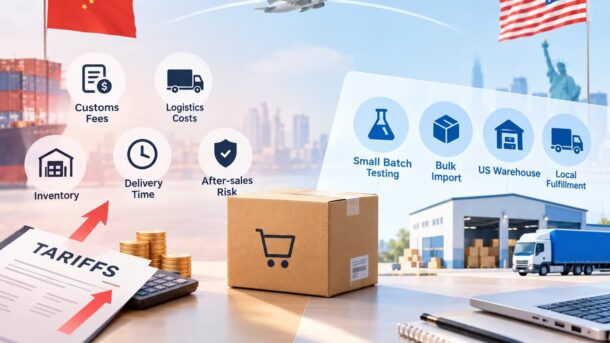
As the cost of cross-border fulfillment changes, more sellers may need to compare direct shipping from China with a hybrid model that combines Chinese suppliers and US-based inventory.
Neither approach is automatically better. The right choice depends on demand, product characteristics, cash flow, and total fulfillment costs.
| Factor | Direct Shipping From China | China Sourcing + US Warehouse |
|---|---|---|
| Initial capital | Generally lower | Higher due to inventory and inbound freight |
| Inventory exposure | Relatively limited | Greater risk of unsold stock |
| International shipping | Typically handled per shipment | Bulk freight may reduce per-unit inbound costs |
| US delivery | Depends on the cross-border shipping method | Uses domestic fulfillment networks |
| Delivery speed | Varies by route and customs processing | Depends on warehouse location and carrier |
| Best suited for | Product testing and uncertain demand | Proven products with more predictable sales |
One important distinction often gets overlooked: bulk shipping does not automatically mean lower import duties.
Consolidating shipments may reduce certain per-unit transportation costs, but duties still depend on the applicable tariff classification, origin, trade measures, and customs valuation rules.
US warehousing also introduces additional expenses, including storage, pick-and-pack fees, inventory management, and return processing.
The goal should therefore be to compare the total cost of delivering an order, not simply the international shipping rate.
How to Calculate the Real Cost of Each Model
For direct shipping, sellers should account for: Product cost + international shipping + applicable import duties and customs fees + payment processing + customer acquisition + expected after-sales costs.
For a US warehouse model, the calculation should include: Product cost + inbound freight + applicable import duties and customs fees + storage and fulfillment fees + domestic shipping + payment processing + customer acquisition + expected after-sales costs.
The comparison becomes more meaningful when both models are evaluated using the same assumptions for order volume, product price, and customer acquisition.
If bulk freight savings outweigh warehousing and inventory costs, local fulfillment may improve profitability. If demand remains unpredictable, holding inventory in the US may introduce more risk than it removes.
A More Flexible Dropshipping Strategy for 2026
Rather than treating direct shipping and US warehousing as mutually exclusive choices, sellers can adapt their fulfillment strategy as their businesses grow.
Stage One: Test Products With Limited Inventory Exposure
For a new product, the priority should be validating demand without committing excessive capital.
Sellers can use samples, small test orders, and compliant cross-border shipping arrangements to evaluate conversion rates, customer feedback, return rates, and actual contribution margins.
At this stage, the objective is not necessarily to achieve the lowest possible shipping cost. It is to determine whether the product has sufficient demand and profitability to justify further investment.
Import duties and customs requirements still need to be considered, even for small test shipments.
Stage Two: Move Proven Products Toward Bulk Import and Local Fulfillment
Once a product demonstrates consistent demand, sellers can compare the economics of individual cross-border shipments with bulk imports and US warehousing.
The decision should take into account:
- Gross margin and contribution margin
- Monthly order volume and demand volatility
- Inbound freight and domestic delivery costs
- Warehouse storage and fulfillment fees
- Replenishment lead times
- Inventory turnover and potential markdowns
- Return rates and working capital requirements
If the savings from bulk transportation and domestic delivery outweigh the additional inventory and warehouse expenses, a US fulfillment partner may become a more attractive option.
But moving inventory too early can tie up cash and create a new problem: unsold stock.
Stage Three: Optimize Fulfillment and Customer Experience
As order volume grows, shipping price is only one part of the equation.
Delivery reliability, order tracking, returns, damaged parcels, and customer support all influence the overall customer experience.
Depending on order distribution and product demand, sellers may consider one US warehouse, multiple fulfillment locations, or a combination of shipping methods.
More warehouses are not automatically better. Additional locations can increase inventory complexity and operating costs.
The objective is to build a fulfillment system that supports profitable growth without adding unnecessary operational complexity.
As Fulfillment Changes, Shipping Risk Deserves More Attention
Moving toward local inventory and domestic delivery can improve the customer experience, but it does not eliminate fulfillment risk.
A parcel can be delayed after leaving the warehouse. An item can arrive damaged. A tracking page may show a delivery confirmation even when the customer says the package never arrived.
These incidents can lead to refunds, replacements, support requests, and potential customer dissatisfaction.
The financial impact can become more significant as average order values increase. A missing $100 order, for example, may represent a much larger exposure than a low-cost accessory, particularly if the seller must also cover reshipping and customer service.
Dropshipping sellers should therefore evaluate not only average fulfillment costs but also the potential impact of exceptions.
A practical risk management strategy may include reliable carriers, clear delivery expectations, shipment tracking, defined claims procedures, and appropriate shipping-related service options.
What Is Shipping Secure, and Why Does It Matter?
Shipping Secure refers here to services designed to provide customers with additional options related to shipment security and delivery issues.
For independent ecommerce merchants, these services can be integrated into the checkout experience and considered alongside broader fulfillment and customer service processes.
They do not replace reliable suppliers, compliant import procedures, or effective logistics operations. Instead, they can form one part of a wider approach to managing shipping-related uncertainty.
For example, Gooval-Shipping Secure Service combines shipping-related service options with customizable checkout add-ons. Depending on the applicable product configuration, merchants can offer customers an option related to shipment security and other merchant-defined benefits.
Before adopting any shipping-related service, merchants should understand:
- Which shipment events are covered
- What exclusions, claim conditions, and payout limits apply
- Who pays the service fee
- Whether merchants can configure additional markups
- How customers submit claims and how those claims are handled
- How the service fits into existing checkout and fulfillment workflows
These details matter more than the product label alone.
Gooval’s approach also extends beyond basic shipping-related services. Its customizable checkout add-ons and post-purchase upgrades can give merchants a way to offer additional buyer benefits, depending on the product configuration.
For Shopify merchants exploring checkout add-ons, the potential value lies in having more flexibility over the services and benefits presented to customers at checkout.
However, results will vary by store, product, audience, and implementation. Shipping Secure should not be treated as a guarantee of higher conversion rates or fewer disputes. Merchants should evaluate its impact using their own order and customer service data.
How Should Dropshipping Sellers Decide What to Do Next?
Instead of asking whether China-to-US dropshipping is still viable in general, sellers should assess three parts of their own business.
1. Calculate Contribution Margin, Not Just Product Margin
Retail price minus supplier cost is not a complete measure of profitability.
Include shipping, import duties, payment fees, customer acquisition, refunds, reshipments, and other relevant operating expenses.
A product is worth scaling only when its contribution margin remains attractive after these costs are considered.
2. Evaluate Demand Before Committing to Inventory
If order volume is inconsistent, direct shipping may help limit inventory exposure while the seller gathers more data.
If demand becomes predictable, bulk imports and US warehousing may offer a better cost and delivery structure.
There is no universal order-volume or average-order-value threshold for making this decision. The right point depends on product dimensions, sales velocity, replenishment time, and cash flow.
3. Build a Plan for Fulfillment Exceptions
Sellers should establish clear procedures for delayed, damaged, or missing shipments.
This includes reviewing carrier performance, defining customer communication processes, understanding applicable service terms, and assessing whether additional shipping-related services fit their business model.
The goal is not to eliminate every possible fulfillment problem. It is to understand the risks, control avoidable costs, and respond consistently when exceptions occur.
The Bottom Line: Dropshipping Is Evolving, Not Disappearing
The US de minimis changes have made the economics of low-value cross-border shipments more complicated. Sellers who relied on inexpensive, individual shipments from China may need to reconsider their pricing, sourcing, and fulfillment strategies.
But dropshipping itself is not over.
Businesses that validate demand, understand landed costs, manage inventory carefully, and build reliable fulfillment processes can still find opportunities in the US market.
The competitive advantage is increasingly about more than sourcing a cheap product. It is about combining a viable product, a sustainable cost structure, and a customer experience that supports repeat business.
For merchants selling to US consumers, three questions deserve attention:
Which fulfillment model fits my product? What is my real profit per order after all costs? And what happens when a shipment goes wrong?
Answering those questions with actual business data is a more reliable path to sustainable growth than assuming one shipping model will work for every product.
Sources and Further Reading
- The White House — Executive order on the continued suspension of duty-free de minimis treatment, February 2026:
https://www.whitehouse.gov/presidential-actions/2026/02/continuing-the-suspension-of-duty-free-de-minimis-treatment-for-all-countries/ - US Customs and Border Protection (CBP) — Guidance on duty treatment for low-value postal shipments:
https://www.help.cbp.gov/s/article/Article-1902?language=en_US - US Government Publishing Office — Federal Register documentation on postal shipment procedures and de minimis-related rules:
https://www.govinfo.gov/content/pkg/FR-2026-06-24/pdf/2026-12670.pdf
Disclaimer: US import rules, tariff rates, and customs procedures can change. This article is for informational purposes only and does not constitute legal, tax, or customs advice. Importers should verify the rules applicable to their products, origin, shipping method, and import date before making business decisions.