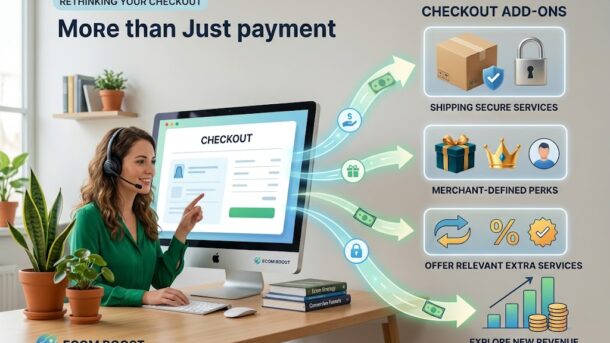
Your Checkout Is More Than a Payment Page. It Can Be a Revenue Channel.
For many Shopify and dropshipping merchants, Checkout Add-Ons offer a way to do more than simply process payments. After investing in product research, advertising, and store design, merchants need a checkout experience that helps turn shoppers into paying customers while creating opportunities for additional revenue.
But checkout can serve another purpose.
With the right checkout add-ons, merchants can offer relevant extra services, deliver more value to buyers, and explore new revenue opportunities without relying entirely on higher product prices or increased advertising spend.
The key is to make every offer useful, transparent, and easy to understand.
From shipping secure services to merchant-defined perks, this guide explores how independent ecommerce stores can rethink checkout and evaluate whether these opportunities fit their business goals.
1. Why Checkout Deserves More Attention
Driving traffic to an online store can be expensive. Yet a shopper who reaches checkout has already shown meaningful purchase intent.
That makes checkout an important point in the customer journey. It is also a sensitive one: unexpected fees, unclear delivery information, and unnecessary steps can undermine a shopper’s confidence.
Shopify’s ecommerce checkout best practices recommend making checkout clear and convenient, displaying costs transparently, and using relevant upsell or cross-sell offers without compromising the purchase experience.
For dropshipping businesses, three questions are especially important:
- Can shoppers understand the total cost? Shipping fees, taxes, and optional services should be clearly explained before payment.
- Do shoppers know what to expect after ordering? Delivery estimates, tracking information, and relevant service terms help set expectations.
- Is there additional value worth offering? Useful services or benefits may give buyers another reason to feel confident about their purchase.
Checkout optimization is not simply about adding more features. It is about removing uncertainty while making relevant offers available at the right moment.
2. What Are Checkout Add-Ons?
Checkout add-ons are optional products, services, or benefits offered alongside a shopper’s primary purchase.
Traditional upselling encourages customers to buy a more expensive product or add another item. Checkout add-ons can take a different approach: they can enhance the original purchase without requiring the customer to choose another physical product.
Examples include:
- Shipping-related services: Optional services associated with eligible shipping risks or delivery issues.
- Convenience benefits: Faster shipping options or other merchant-defined service upgrades, where available.
- Customer incentives: Return vouchers, repurchase coupons, or exclusive content.
- Relevant product extras: Accessories, complementary products, or additional quantities.
For example, a dropshipping store selling home accessories might offer a relevant add-on alongside a customer’s order. A beauty store might offer a repurchase voucher, while a store selling higher-value products might offer an eligible shipping secure service.
The goal is not to present every shopper with a long list of extras. It is to identify which offers fit the product, the customer, and the purchase context.
How to Choose the Right Add-Ons
Before introducing a checkout add-on, evaluate it against four criteria:
- Relevance: Does it address a real customer need?
- Clarity: Can shoppers understand what they receive and what it costs?
- Convenience: Does the offer fit naturally into the buying journey?
- Commercial value: Does the potential revenue justify the operational and customer-experience trade-offs?
Start with one or two relevant offers, then measure their performance before expanding.
3. Shipping Secure Services: An Opportunity Beyond Product Upselling
Not every checkout add-on needs to be another product.
For independent stores and dropshipping businesses, shipping-related concerns can continue after the payment is completed. Parcels may be lost, damaged, or delayed. Depending on the situation, these incidents can lead to customer inquiries, refunds, replacement shipments, and additional administrative work.
Merchants can respond by improving their delivery communication, setting realistic expectations, and evaluating appropriate shipping-related services.
A Shipping Secure Service can give eligible buyers an optional way to access specified shipping-related benefits, subject to the service’s terms and coverage conditions.
This creates a different type of checkout offer. Instead of asking customers to buy another physical item, the merchant presents a service connected to the order they are already placing.
For the merchant, the potential benefits include:
- Offering buyers an additional service relevant to their purchase.
- Providing a clearer way to communicate the availability and terms of shipping-related assistance.
- Exploring a buyer-funded add-on rather than absorbing every service cost into the product price.
- Potentially reducing some manual claims-related work when the service provider manages the applicable claims process.
These benefits depend on the service design, eligibility requirements, customer adoption, and actual operating arrangements. A shipping secure service does not eliminate every delivery problem, and merchants should avoid presenting it as a guarantee against all shipping-related losses.
The practical objective is to make the offer understandable and useful—not to create unnecessary anxiety about delivery.
4. Merchant-Added Markup: Create an Additional Revenue Opportunity
One checkout revenue model worth understanding is merchant-added markup.
In a buyer-funded service model, a customer pays for an optional service associated with their order. Depending on the platform and commercial arrangement, a merchant may be able to add an optional markup to the service price.
The merchant retains the markup they set under the applicable model, creating a potential source of incremental revenue.
Consider a simplified example.
Illustrative example—not a forecast or a guaranteed return.
Suppose a merchant offers an eligible service with a base price of $2.00 and adds a $0.75 markup.
- Base service price: $2.00
- Merchant-added markup: $0.75
- Total displayed service price: $2.75
- Merchant’s markup component: $0.75
If 100 customers purchase the service, the merchant-added markup would total $75 before any applicable adjustments, taxes, refunds, or other contractual considerations.
This calculation illustrates the markup component only. It does not establish the merchant’s total profit, the provider’s revenue allocation, or the overall financial outcome of the store.
How to Set a Reasonable Markup
A markup should reflect the value offered to customers, the price sensitivity of the target audience, and the applicable service terms.
Merchants should consider the following:
- Start with customer value. A price is easier to justify when the service and its benefits are clearly explained.
- Keep the offer transparent. Buyers should understand that the service is optional and see its price before purchasing.
- Test different price points carefully. Compare adoption rates, revenue per eligible order, and any changes in checkout completion.
- Measure more than gross revenue. Account for refunds, applicable taxes, contractual adjustments, and any other costs when evaluating the financial result.
The purpose of merchant-added markup is not to maximize the price at any cost. It is to create a commercially sensible offer that buyers can evaluate for themselves.
5. Merchant-Defined Perks: Give Customers a Reason to See More Value
Revenue opportunities do not have to come from shipping-related services alone.
Merchants can also differentiate their stores by offering merchant-defined perks—benefits selected or configured around their business model and customer needs.
Depending on the capabilities of the platform, these might include:
- Return vouchers or repurchase coupons.
- Fast-shipping benefits where available.
- Exclusive content or other customer privileges.
- Store-specific offers designed to encourage future engagement.
For example, a dropshipping store selling hobby products could offer buyers exclusive instructional content. A fashion store might provide a repurchase voucher for a future order. A merchant with a suitable fulfillment arrangement could offer a qualifying faster-shipping benefit.
These perks can help a store communicate value beyond the product itself.
However, their effectiveness depends on relevance and execution. A voucher that customers never redeem may have little practical value, while a poorly explained perk may create confusion rather than improve the shopping experience.
How to Design Perks That Make Commercial Sense
Begin by identifying a specific business objective.
- Encourage repeat purchases: Consider a clearly defined repurchase voucher.
- Differentiate the customer experience: Offer relevant content or a meaningful service benefit.
- Support a stronger value proposition: Combine a suitable shipping secure service with benefits that match the store’s audience.
- Build a more distinctive brand: Create perks that reflect what makes the store different from competing sellers.
Keep the terms clear, including eligibility, expiry dates, redemption conditions, and any limitations.
Most importantly, evaluate perks based on actual usage and customer response rather than assuming that adding more benefits will automatically increase sales.
6. How to Evaluate Whether Checkout Add-Ons Are Working
Adding an offer is only the beginning. Merchants need to understand whether it improves the overall economics of the store.
A simple measurement framework can help.
| Metric | What it tells you |
|---|---|
| Add-on adoption rate | The share of eligible orders that include the offer |
| Add-on revenue per eligible order | The revenue generated by the offer across eligible orders |
| Checkout completion rate | Whether more shoppers complete the purchase |
| Average order value (AOV) | Whether the average order value changes |
| Refund and cancellation rate | Whether the offer creates unexpected friction or disputes |
| Repeat purchase rate | Whether customer incentives are associated with subsequent orders |
Track the baseline before launching a new offer. Then compare results over a defined period while accounting for changes in traffic sources, product mix, promotions, and seasonality.
For example, an add-on may generate revenue but also introduce confusion that reduces checkout completion. Conversely, an offer may have modest adoption yet provide value to customers who choose it.
The relevant question is not simply, “How much revenue did the add-on generate?”
It is, “Did this offer create worthwhile incremental value without undermining the original purchase?”
Where possible, use controlled tests to separate the effect of the add-on from other changes to the store.
7. How Gooval Helps Merchants Explore Checkout Revenue Opportunities
For merchants who want to explore this approach, Gooval-Shipping Secure Service brings shipping-related services and merchant-defined perks into a configurable offering.
Gooval is designed for independent ecommerce merchants who want to offer optional checkout add-ons and post-purchase upgrades.
Its approach combines two elements: Shipping Secure Service
Eligible buyers can opt into a buyer-funded service associated with specified shipping-related scenarios, including lost, damaged, or delayed parcels, subject to the applicable terms. The relevant claims process is handled through the service arrangement, helping reduce the need for merchants to manage every eligible case themselves.
Merchant-Defined Perks
Merchants can configure benefits such as return vouchers, fast-shipping benefits, and exclusive content according to the options available to their store. This allows them to explore offers that fit their audience rather than relying on a one-size-fits-all upsell.
Merchant-Added Markup
Merchants may set an optional markup on the service under Gooval’s applicable commercial model. The merchant retains the markup they set, subject to the relevant terms. This creates an additional revenue opportunity without requiring the merchant to increase the price of every product.
Configuration and Reporting
Gooval provides a private dashboard for configuring perks, setting markups, and viewing reports, helping merchants manage their offering in one place.
The value of this approach is not that every store will achieve the same financial result. It is that merchants can evaluate a different way to combine customer value, shipping-related services, and checkout revenue.
Before enabling an offer, merchants should review its eligibility, pricing, service terms, and compatibility with their store’s configuration.
8. A Practical Checklist Before Launching a Checkout Add-On
Use this checklist to assess whether your store is ready.
- Identify a genuine customer need that the add-on addresses.
- Explain the service or perk in plain language.
- Make the optional price and applicable terms clear before purchase.
- Confirm compatibility with your Shopify plan, checkout setup, and installed apps.
- Keep the checkout experience focused and mobile-friendly.
- Establish baseline metrics before launch.
- Track adoption, revenue, checkout completion, refunds, and customer feedback.
- Review results and adjust the offer based on evidence.
Avoid launching multiple add-ons at once if you cannot determine which one is affecting performance. A focused test makes it easier to learn what works for your particular audience.
Final Thoughts: Make Checkout Work Harder Without Making It Harder to Use
For Shopify and dropshipping merchants, checkout is more than the final step in collecting payment. It is an opportunity to offer relevant services, communicate additional value, and explore revenue streams beyond product sales.
The most effective strategy starts with the customer. Keep the buying process simple, make optional offers transparent, and measure the commercial impact before scaling.
Shipping secure services, merchant-added markup, and merchant-defined perks offer three ways to explore that opportunity.
Gooval-Shipping Secure Service helps merchants bring these elements together in a configurable checkout offering. Rather than treating shipping-related services as an isolated operational concern, merchants can evaluate how they fit into a broader strategy for customer value and incremental revenue.
Ready to Explore a New Revenue Opportunity at Checkout?
If you run a Shopify store or dropshipping business, take a closer look at how buyer-funded shipping secure services and merchant-defined perks could fit your checkout strategy.
Explore Gooval-Shipping Secure Service on the Shopify App Store to learn more about its features and configuration options.
To learn more about Gooval, you can visit gooval.io for details.
Start with a relevant offer, keep the terms transparent, and use real store data to determine what works for your business.