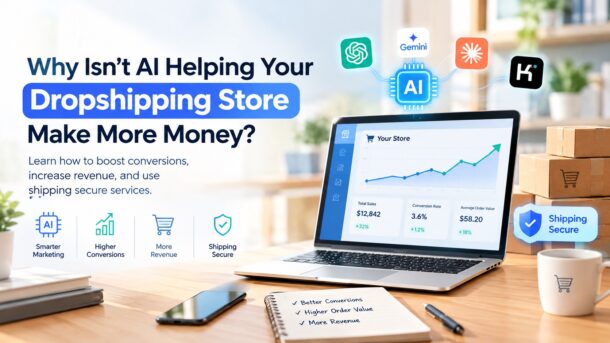
AI tools such as ChatGPT, Gemini, Claude, and Kimi are making AI for Dropshipping more accessible than ever, helping ecommerce merchants research products, create marketing content, analyze trends, and streamline daily operations. Yet many business owners still face the same question: if AI can save so much time, why isn’t it helping them make more money?
For merchants exploring AI-powered growth, the answer goes beyond technology. Rising advertising costs, intense competition, and pressure on profit margins mean that working faster does not always translate into earning more. Sustainable growth depends on turning traffic into paying customers, increasing order value, and improving the profitability of every sale.
1. AI Can Improve Efficiency, but Not Guarantee Profit
AI has become a useful assistant for ecommerce entrepreneurs. It can help generate product descriptions, brainstorm advertising creatives, answer common customer questions, and identify potential product trends.
These improvements can save time and reduce repetitive work. However, efficiency and profitability are two different things.
A business can publish more content without attracting qualified visitors. It can launch more advertisements without improving conversion rates. It can even process more orders while earning less profit per order.
AI helps merchants execute tasks faster, but it cannot guarantee that their underlying business decisions are right. Sustainable growth still requires a clear understanding of customer needs, pricing, conversion performance, and operating costs.
Ultimately, AI for Dropshipping is most valuable when it supports better business decisions, from understanding customer needs to improving conversion rates and managing operating costs.
2. More Traffic Doesn’t Always Mean More Revenue
Customer acquisition is often one of the biggest challenges for online merchants. Businesses invest in advertising, social media content, influencer partnerships, and search visibility to bring shoppers to their websites.
But attracting visitors is only the beginning.
If shoppers leave without purchasing, advertising spend produces little return. If customers complete a purchase only when offered a deep discount, the business may sacrifice too much margin. And if average order value remains low, rising acquisition costs can make growth increasingly difficult.
Three questions are particularly important:
- Are visitors converting? Review product pages, shipping information, checkout friction, and customer confidence.
- Is each order valuable enough? Explore relevant add-ons, bundles, and complementary services that genuinely benefit buyers.
- Is each sale profitable? Account for product costs, advertising, payment fees, fulfillment expenses, refunds, and other operating costs.
With the right approach to AI for Dropshipping, merchants can turn customer and sales data into actionable insights instead of focusing solely on generating more traffic.
3. Your Checkout May Be an Overlooked Revenue Opportunity
Many merchants spend considerable time optimizing product pages and advertising campaigns, yet treat checkout as little more than a place to collect payment.
This can mean overlooking an important opportunity. By the time shoppers reach checkout, they have already expressed interest in a product. Instead of relying exclusively on more traffic, merchants can explore whether the checkout experience could deliver additional value through relevant, optional services.
Depending on the store’s setup and available features, these opportunities may include complementary products, useful order-related services, or other checkout add-ons that fit the buyer’s needs.
The key is relevance. An add-on should be easy to understand, provide a clear benefit, and avoid creating unnecessary friction at the moment of purchase.
When implemented thoughtfully, checkout add-ons can create additional revenue opportunities without requiring merchants to depend entirely on increased advertising spend.
4. How Shipping Secure Services Can Create Additional Value
Shipping concerns can influence how customers feel about an online purchase, particularly when orders travel long distances or pass through multiple fulfillment stages.
Offering a relevant shipping secure service at checkout can give buyers an additional option while creating a potential revenue stream for merchants.
This is where Gooval–Shipping Secure Service can fit into a broader checkout strategy.
Gooval enables merchants to offer buyers a shipping secure service alongside merchant-defined perks. Depending on the store’s configuration, these perks may include return vouchers, fast-shipping options, or exclusive content. Merchants can configure their offerings and optional markups through a private dashboard.
This model gives merchants another way to explore checkout revenue beyond the products they sell. Buyers can choose relevant services, while merchants can decide how to structure their own optional offerings and pricing.
For merchants exploring this approach, the opportunity is not simply to add another fee. It is to offer something customers understand and value, while creating a checkout experience that supports customer confidence and business growth.
Any service should be presented transparently, with its price, scope, and applicable terms clearly explained.
5. Why This Matters for Dropshipping Businesses
Online merchants often have limited control over suppliers, shipping timelines, and fulfillment processes. At the same time, customers expect a smooth purchasing experience and clear communication when something goes wrong.
This creates a challenge: businesses need to build customer trust without allowing every operational issue to consume their time and resources.
A well-designed checkout strategy can help address part of that challenge. Relevant add-ons may give buyers more choice, while appropriate service arrangements can clarify what support is available for qualifying shipping issues.
However, merchants should evaluate any solution based on its actual terms, supported scenarios, integration requirements, and operational impact. Not every service will suit every business model, product category, or destination market.
The goal is to find solutions that fit the business, improve the buyer experience, and contribute to sustainable margins rather than adding complexity for its own sake.
6. A Practical Growth Framework for AI-Powered Ecommerce
A practical AI for Dropshipping strategy should connect automation with measurable business outcomes rather than adopting new tools simply because they are available.
First, use AI to reduce repetitive work. Apply it to product research, content drafts, customer-question analysis, and routine operational tasks. Review important outputs before publishing or acting on them.
Second, identify where customers drop off. Review website analytics, product-page performance, cart abandonment, and checkout conversion. Use these findings to prioritize improvements rather than making changes based on assumptions.
Third, test ways to increase order value. Consider bundles, complementary products, and relevant checkout add-ons. Measure the effect on average order value and conversion rate, not revenue alone.
Fourth, review profit at the order level. More sales do not necessarily mean better results. Track the costs associated with acquiring, processing, and fulfilling each order.
Finally, keep the customer experience simple. Every additional feature or service should have a clear purpose. If it confuses buyers or adds unnecessary friction, it may undermine the value it was meant to create.
These steps help merchants connect AI adoption with practical improvements across marketing, checkout, and profitability.
Conclusion: Make AI Work for Your Business
AI is changing how ecommerce businesses operate, but access to better tools does not automatically create a better business.
Merchants need more than faster content production or additional advertising campaigns. They need a clear understanding of customer behavior, a checkout experience that encourages confident purchases, and a strategy for improving revenue without losing sight of margins.
AI can help merchants identify opportunities and execute their plans more efficiently. Checkout add-ons and shipping secure services can provide additional ways to create buyer value and explore revenue growth.
The future of AI for Dropshipping is not just about doing more work in less time. It is about using technology alongside smarter checkout experiences, relevant shipping secure services, and better profit management to build a more sustainable ecommerce business.