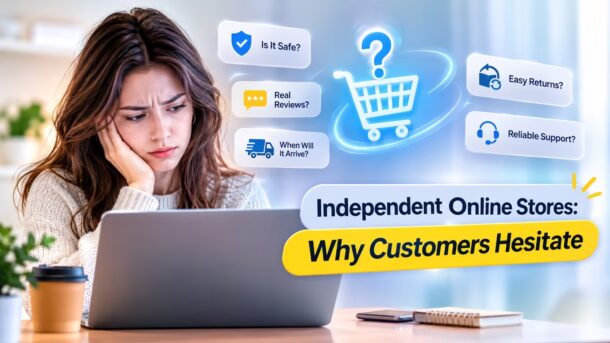
Independent online stores face a unique challenge: convincing customers to trust a brand they may have never purchased from before.
A customer visits an online store, finds a product they like, checks the price, and adds it to their cart. But just before completing the purchase, they stop. They open another browser tab, search for the brand, look for customer reviews, check the shipping policy, and perhaps leave without buying anything.
Why does this happen?
For many shoppers, the hesitation is not necessarily about the product itself. It is about the uncertainty surrounding the purchase. They may wonder whether the store is legitimate, whether the product will match its description, whether payment is secure, or what will happen if something goes wrong after the order is placed.
For independent online stores, building customer trust is therefore more than a branding exercise. It is an essential part of turning visitors into buyers.
1. Lack of Brand Recognition Makes First-Time Purchases Feel Riskier
One of the biggest challenges for independent online stores is that customers may not recognize the brand.
When shoppers buy from a well-known retailer, they often have some expectations about product quality, payment processes, shipping, and customer service. Familiarity makes the purchase feel more predictable.
An unfamiliar independent store does not automatically benefit from that confidence.
Even when a website looks professional and its products are attractive, first-time visitors may still ask themselves:
- Is this a legitimate business?
- Will I actually receive the product?
- Is the product quality consistent with the description?
- Can I contact the seller if there is a problem?
These questions are particularly important when customers are spending money with a brand they have never encountered before.
For merchants, this means that a professional-looking website alone may not be enough. Clear business information, accessible contact details, transparent policies, and consistent brand communication all help reduce uncertainty.
Customers need reasons to believe that there is a real business behind the website.
2. A Lack of Authentic Customer Reviews Creates Doubt
Customer reviews play an important role in online shopping because they help people evaluate products and brands before making a decision.
When customers cannot find genuine feedback, they have fewer ways to assess whether a store is trustworthy.
This can create a difficult situation for newer independent online stores. They need customer feedback to build credibility, but they also need customers to make purchases before they can accumulate meaningful reviews.
The solution is not simply to display as many reviews as possible. Shoppers increasingly pay attention to whether feedback appears authentic and relevant.
Merchants can build credibility by:
- Encouraging customers to leave honest feedback after a purchase.
- Displaying verified reviews where available.
- Including real product photos and detailed product information.
- Responding professionally to both positive and negative feedback.
- Avoiding exaggerated claims that are difficult to substantiate.
A small collection of genuine, useful reviews can be more convincing than a large volume of feedback that lacks detail or credibility.
Trust is built when the information presented to customers feels consistent with their actual shopping experience.
3. Uncertainty About Payment Security Makes Customers Think Twice
Payment is one of the most sensitive stages of the online shopping journey.
Customers may be willing to browse an unfamiliar store, but entering their payment details requires a higher level of confidence. If the checkout page looks unfamiliar, the payment process is unclear, or important information is missing, shoppers may decide not to proceed.
Independent online stores should make the payment experience as clear and reassuring as possible.
This includes using recognized payment methods, maintaining a secure checkout environment, displaying accurate order totals, and explaining any additional charges before customers complete their purchase.
Merchants should also avoid unnecessary steps during checkout. Requiring excessive information or presenting unexpected costs can make customers question the transaction.
A smooth payment experience does not guarantee a completed purchase, but an unclear or confusing one can easily become a reason to abandon it.
4. Unclear Shipping and Delivery Expectations Create Purchasing Anxiety
Customers do not evaluate an online purchase based only on the product and its price. They also consider how the order will reach them.
Shipping uncertainty can be particularly concerning when customers are buying from an unfamiliar independent online store.
Questions often include:
- How long will delivery take?
- Which carrier will handle the shipment?
- Will tracking information be available?
- What happens if the package is delayed?
- Who should I contact if the order is lost or damaged?
If a store provides only vague shipping information, customers may hesitate to complete their purchase.
For merchants, shipping transparency should be treated as part of the overall customer experience, not simply an operational detail.
A clear shipping policy should explain estimated delivery timeframes, available shipping methods, tracking arrangements, and the process for handling delivery-related issues.
It is equally important to communicate realistic expectations. Promising delivery times that cannot be consistently met may create short-term sales opportunities but can damage customer confidence in the long run.
Customers do not necessarily expect every order to arrive immediately. They do, however, want to know what to expect and what support is available if something goes wrong.
5. Complicated Return and Refund Policies Increase Perceived Risk
Before purchasing from an unfamiliar store, customers often consider what will happen if the product does not meet their expectations.
Can they return it? Will they receive a refund? Who pays for return shipping? How long will the process take?
If these details are difficult to find or written in confusing language, customers may see the purchase as a greater risk.
Independent online stores should make their return and refund policies easy to locate and understand.
A clear policy should explain:
- Which products are eligible for return.
- The conditions and timeframe for requesting a return.
- How customers can initiate the process.
- How refunds are handled and when customers can expect them.
- Any applicable exclusions or special conditions.
The goal is not to promise unlimited returns or refunds. It is to help customers understand their options before they buy.
When shoppers know what to expect, they can make more informed purchasing decisions. Clear policies also help merchants manage expectations and reduce avoidable disputes.
6. The Lack of Post-Purchase Support Can Undermine Customer Confidence
Customer trust does not end when an order is paid for.
In fact, the period after checkout is often when customers begin to evaluate whether the store delivers on its promises.
They may need order updates, shipping information, delivery assistance, or help with a product-related issue. If the merchant provides no clear way to get support, customers may feel uncertain about what to do next.
This is an important challenge for independent online stores, particularly those operating with small teams and limited customer service resources.
Merchants can improve the post-purchase experience by providing:
- Timely order confirmation and shipping notifications.
- Accessible customer support channels.
- Clear instructions for reporting order-related issues.
- Consistent communication when problems occur.
- A straightforward process for handling eligible requests.
For delivery-related situations, merchants can also consider offering additional services that give customers clearer options when something goes wrong.
For example, Gooval’s Shipping Secure Service allows independent ecommerce merchants to offer customers an optional service at checkout. Merchants can also configure additional customer benefits, such as return vouchers, free shipping, and expedited delivery, depending on their business needs.
For eligible situations including loss in transit, damage in transit, delivery delays, and theft or porch piracy, customers can submit requests directly through the service, subject to the applicable terms. This can reduce the need for merchants to manually handle every delivery-related request.
The broader point is that post-purchase support should be considered part of the shopping experience from the beginning, rather than something merchants address only after a problem occurs.
Building Customer Trust Is a Business Strategy, Not Just a Website Design Task
Why do customers hesitate to buy from independent online stores?
The reasons often go beyond product price or website appearance. Customers may be unfamiliar with the brand, unable to find credible reviews, uncertain about payment security, or unclear about shipping, returns, and post-purchase support.
These concerns share one underlying issue: uncertainty.
For independent online stores, improving conversion is not simply about adding more promotional banners, offering discounts, or driving additional traffic. It is also about making customers feel more confident at every stage of the buying journey.
That confidence comes from consistent details: accurate product descriptions, authentic customer feedback, transparent policies, familiar payment options, reliable shipping information, and accessible support.
A customer may discover a store because of its products, but the overall shopping experience influences whether they feel comfortable placing an order.
Ultimately, the goal is not just to persuade customers to click Buy Now. It is to give them enough confidence to make the purchase — and enough reassurance to consider coming back again.