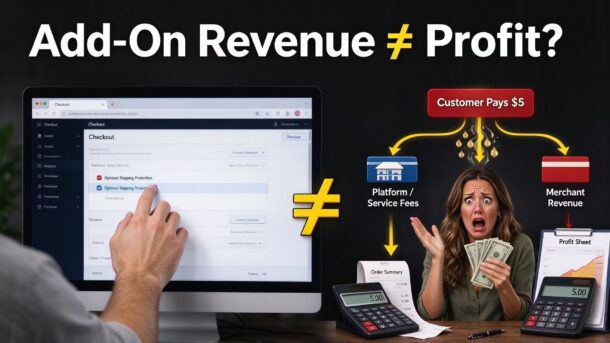
Ecommerce checkout add-ons can create new revenue opportunities for online stores, but they do not automatically improve profitability. For Shopify merchants, direct-to-consumer (DTC) brands, and dropshipping businesses, the real question is whether these optional services generate enough incremental profit to cover their costs without hurting checkout conversion rates.
A checkout add-on might offer shipping-related services, future-order rewards, or other merchant-defined benefits. When designed well, it can give customers more choice while helping merchants create additional value from existing orders. When designed poorly, however, it can introduce extra costs, increase checkout friction, or reduce customer trust.
The key is to measure the financial impact of ecommerce checkout add-ons at the order level, rather than judging their performance by revenue alone.
What Are Ecommerce Checkout Add-Ons?
Ecommerce checkout add-ons are optional services, benefits, or offers presented during the purchase process. Customers can choose whether to accept them, depending on how the merchant configures the checkout experience.
Common examples include:
- Shipping-related services: Optional services designed to address eligible package loss, damage, or delivery-delay events.
- Future-purchase rewards: Coupons or store credits that encourage customers to return.
- Merchant-defined perks: Benefits such as free shipping on a future order, exclusive content, or other offers selected by the merchant.
- Additional purchase options: Relevant services or upgrades that customers may choose alongside their main purchase.
These offers serve different purposes. A shipping-related service may provide value through eligible delivery-related coverage, while a future-order reward may encourage repeat purchases. Their financial models and operating costs should therefore be evaluated separately.
For merchants, the objective is not simply to add more options to checkout. It is to determine whether an additional offer improves the economics of each order and the overall customer experience.
How Ecommerce Checkout Add-Ons Affect Profit Margins
To evaluate ecommerce checkout add-ons properly, merchants need to distinguish between three financial outcomes: additional revenue, incremental costs, and changes in the underlying purchase conversion rate.
1. Additional Revenue Is Not the Same as Additional Profit
Suppose an online store introduces an optional service that customers can purchase at checkout. The store may receive a share of the service revenue or retain an additional markup, depending on the provider’s commercial model.
However, the amount customers pay is not necessarily the amount the merchant keeps.
A merchant should distinguish between:
- Gross customer payments: The total amount customers pay for the optional service.
- Merchant-retained revenue: The portion the merchant actually receives after applicable provider fees or revenue-sharing arrangements.
- Incremental costs: Additional expenses associated with providing the service, fulfilling rewards, or managing related operations.
- Incremental profit: The merchant’s additional earnings after accounting for the relevant costs.
This distinction matters because a checkout offer can generate substantial transaction volume without contributing much to the merchant’s bottom line.
2. Merchant-Defined Perks Have Their Own Costs
Some ecommerce checkout add-ons provide an opportunity to offer customers additional benefits, such as a coupon for a future order or a free-shipping reward.
These benefits can encourage repeat purchases, but their face value should not be confused with their actual cost.
For example, a coupon offering $10 off a future purchase does not necessarily cost the merchant $10 for every coupon issued. The actual cost depends on redemption, order eligibility, product margins, and whether the discount generates an incremental purchase.
Merchants should track at least three metrics:
- Reward issuance rate: The percentage of eligible orders receiving a reward.
- Reward redemption rate: The percentage of issued rewards that customers redeem.
- Incremental contribution profit: The additional profit generated by purchases attributable to the reward, after accounting for discounts and associated costs.
A reward that is frequently redeemed is not automatically successful. The important question is whether it generates purchases that would not otherwise have occurred and whether those purchases remain profitable.
3. Checkout Conversion Can Change the Entire Calculation
An add-on may generate extra revenue from customers who accept it, but the offer could also introduce friction for customers who would otherwise complete their purchases.
Potential problems include unclear pricing, excessive checkout elements, confusing descriptions, and the impression that an optional service is mandatory.
This means merchants should evaluate both the revenue generated by the add-on and any change in the conversion rate of the underlying checkout.
A useful starting point is to compare two scenarios:
- Baseline: The store’s existing checkout without the new add-on.
- Test: The same checkout with the optional service or benefit added.
Ideally, the comparison should use a randomized test or another reliable method that accounts for differences in traffic sources, customer mix, and seasonality.
The result should be measured in contribution profit per eligible checkout session, not just the add-on acceptance rate.
How to Calculate the Profitability of Ecommerce Checkout Add-Ons
A practical model helps merchants determine whether an add-on creates meaningful financial value.
The following example uses hypothetical figures for illustration. It is not a forecast or a claim about the performance of any particular app.
Step 1: Calculate the Add-On Revenue
Assume an online store processes 1,000 eligible checkout sessions per month.
Its baseline purchase conversion rate is 3%, resulting in 30 orders. After introducing an optional checkout service, the store records 30 completed orders and 6 customers purchase the add-on.
Assume each participating customer pays $5 for the service.
| Metric | Baseline | With add-on |
|---|---|---|
| Eligible checkout sessions | 1,000 | 1,000 |
| Completed orders | 30 | 30 |
| Add-on purchases | 0 | 6 |
| Customer payments for add-ons | $0 | $30 |
The add-on generates $30 in gross customer payments.
However, the merchant should not immediately record the entire $30 as incremental profit. The amount retained by the merchant depends on the service agreement, provider fees, and any other applicable costs.
Step 2: Calculate the Merchant’s Retained Revenue
Suppose, for illustration, that the merchant retains 40% of the $30 in add-on revenue under a hypothetical revenue-sharing arrangement.
The calculation is:
Merchant-retained revenue = Gross add-on revenue × Merchant share
$30 × 40% = $12
The merchant retains $12 before accounting for any additional merchant-borne costs.
The remaining $18 goes to the other party or parties under this hypothetical arrangement. Actual allocations depend on the specific commercial agreement.
This example illustrates why gross customer payments and merchant earnings should be tracked separately.
Step 3: Subtract the Cost of Merchant-Defined Perks
Now suppose the merchant also offers a future-purchase reward.
For the month, the merchant estimates that the rewards redeemed during the measurement period create $4 in incremental costs attributable to the offer. This figure is an illustrative assumption, not a universal cost benchmark.
The add-on contribution before considering any change in the underlying checkout conversion is:
Add-on contribution = Merchant-retained revenue − Incremental add-on costs
$12 − $4 = $8
The add-on contributes $8 under these assumptions, before accounting for any conversion impact, additional operating costs, or other relevant financial effects.
If a merchant also adds a markup to a service, that markup should be included in the calculation only to the extent that it is actually retained under the applicable agreement.
Step 4: Account for Changes in Checkout Conversion
The previous calculation assumes the add-on does not change the number of completed orders. That assumption must be tested rather than taken for granted.
Suppose the store’s baseline contribution profit is $20 per completed order after variable costs, and the add-on test results in one fewer completed order per 1,000 eligible checkout sessions.
The estimated change in total contribution profit becomes:
| Component | Incremental profit impact |
|---|---|
| Merchant-retained add-on revenue | +$12 |
| Incremental reward costs | -$4 |
| Lost contribution from one fewer order | -$20 |
| Net incremental contribution profit | -$12 |
Despite generating $12 in retained revenue, the offer produces a negative net result in this hypothetical scenario because the lost order contributes more profit than the add-on generates.
The calculation demonstrates why checkout conversion must be part of the analysis.
For a real test, merchants should use observed results, account for statistical uncertainty, and include any other incremental costs that apply. A single month’s difference may not be enough to establish that an add-on caused a change in conversion.
A Practical Framework for Measuring Add-On Profitability
Merchants can use the following formula to estimate the incremental contribution profit of a checkout add-on:
Incremental contribution profit = Retained add-on revenue + Incremental contribution from attributable repeat purchases − Incremental reward costs − Other incremental costs − Lost contribution from conversion changes
Each component needs a consistent measurement period and a clear definition.
For example, if a future-order reward generates additional purchases, merchants should count the contribution profit attributable to those purchases rather than counting the entire order value as profit. They should also avoid double-counting revenue or costs already included in the original order calculation.
To compare results across stores or campaigns, merchants can calculate the following metrics:
| Metric | What it tells you |
|---|---|
| Add-on acceptance rate | How often eligible customers purchase the optional offer |
| Merchant-retained revenue per eligible checkout | How much revenue the merchant retains relative to checkout opportunities |
| Incremental cost per eligible checkout | The additional cost associated with the offer |
| Checkout conversion rate | Whether the proportion of completed purchases changes |
| Incremental contribution profit per checkout | Whether the offer improves the economics of the overall purchase process |
These metrics provide a more complete view than add-on revenue alone.
How Gooval Fits Into the Ecommerce Checkout Add-On Model
Gooval-Shipping Secure Service is one example of how an independent online store can offer an optional service alongside its existing checkout experience.
Gooval allows participating merchants to offer buyers a Shipping Secure Service and configure merchant-defined perks. Depending on the merchant’s setup, those perks may include benefits such as future-order discounts, free shipping, or other offers chosen by the merchant.
The service is paid for by the buyer, and merchants may configure their own optional markup on top of the applicable service fee. The merchant’s actual retained earnings depend on the configured commercial terms and revenue-sharing arrangement.
This creates several distinct elements that merchants should evaluate separately:
- Shipping Secure Service revenue. Merchants should measure the amount generated by buyers who choose the service and distinguish gross customer payments from the amount retained by the merchant.
- Merchant-defined perks. Merchants should evaluate the cost of providing each benefit, its redemption rate, and whether it generates additional profitable purchases.
- Checkout conversion. Merchants should monitor whether adding an optional service changes checkout completion rates, average order value, or other relevant purchase metrics.
- Overall contribution profit. The final assessment should combine retained revenue, incremental costs, and any measurable changes in the underlying purchase economics.
Gooval’s model is therefore relevant to merchants exploring ecommerce checkout add-ons as a potential revenue opportunity. Its financial value for an individual store should be assessed using the store’s own transaction data, configuration, costs, and customer behavior rather than assumed in advance.
Which Stores Should Consider Ecommerce Checkout Add-Ons?
Not every store needs another checkout offer. The decision depends on the business model, customer expectations, product economics, and the type of benefit being offered.
Shopify and DTC Brands
Stores with established traffic and sufficient order volume may be able to test optional services and measure their financial effects. A useful starting point is to identify an existing customer need that the offer addresses, then evaluate acceptance, conversion, and contribution profit.
Dropshipping Businesses
Dropshipping merchants may have limited control over fulfillment, making clear delivery expectations and customer communication particularly important. They should evaluate whether a shipping-related service fits their actual shipping arrangements and whether the applicable terms match the risks customers face.
Stores Focused on Repeat Purchases
Merchants selling consumables, accessories, or other products with natural repeat-purchase cycles may find future-order rewards worth testing. The relevant question is whether the reward increases profitable repeat purchases rather than simply discounting purchases customers would have made anyway.
Stores With Low Margins
Low-margin businesses should be especially cautious. Even a small decline in checkout conversion or an unexpected increase in reward costs can outweigh the additional revenue generated by an add-on.
For these stores, testing should begin with a clear baseline and a conservative profitability model.
Common Mistakes When Evaluating Checkout Add-Ons
Several measurement errors can make an unprofitable offer appear successful.
Mistake 1: Treating gross customer payments as merchant profit. Revenue-sharing arrangements, service fees, and other costs determine what the merchant actually retains.
Mistake 2: Ignoring reward redemption costs. A benefit may appear inexpensive when issued but become costly when customers redeem it. Its actual financial effect depends on the reward design and resulting customer behavior.
Mistake 3: Measuring acceptance without measuring conversion. A high acceptance rate does not prove that the offer improves total profitability.
Mistake 4: Assuming every repeat purchase is incremental. Some customers would have returned without the reward. Merchants should use appropriate comparisons to estimate the additional purchases attributable to the offer.
Mistake 5: Drawing conclusions from too little data. Conversion rates fluctuate. Merchants should use sufficient observations, comparable test groups, and a consistent measurement period before making major decisions.
Mistake 6: Ignoring customer trust. Optional services should have clear descriptions, transparent prices, and understandable terms. Customers should be able to distinguish an optional offer from a required purchase component.
Final Thoughts: Measure Profit, Not Just Add-On Revenue
Ecommerce checkout add-ons can create an additional revenue stream, introduce useful customer benefits, and provide merchants with new ways to differentiate their stores. But their value depends on the economics of the complete transaction.
Before implementing an offer, merchants should establish a baseline, calculate retained revenue, estimate incremental costs, measure any change in checkout conversion, and evaluate the resulting contribution profit.
For Shopify merchants, DTC brands, and dropshipping businesses, the most useful question is not simply whether customers will purchase an add-on. It is whether the offer creates measurable incremental value without undermining the original sale or the customer experience.
Solutions such as Gooval-Shipping Secure Service can provide one way to explore this opportunity through buyer-paid services and merchant-defined perks. The right decision, however, should always be based on transparent terms, actual store performance, and a clear understanding of both the additional revenue and the costs required to generate it.