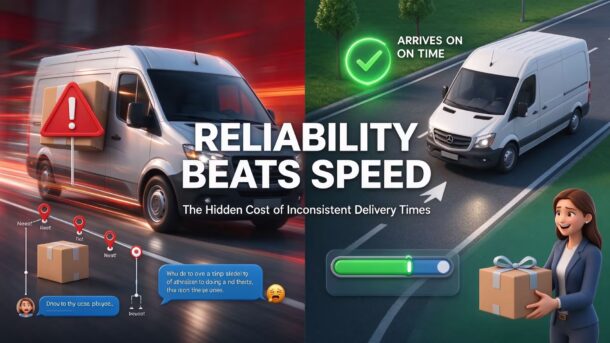
Inconsistent delivery times are becoming a serious challenge for ecommerce businesses, particularly independent online stores and dropshipping brands that rely on third-party suppliers and shipping carriers. While many merchants focus on offering faster shipping, unpredictable delivery schedules can create a much bigger problem: rising customer support costs, declining customer trust, abandoned purchases, and lost repeat sales. In today’s competitive ecommerce market, reliable delivery is not simply a logistics issue. It is an important part of the customer experience and long-term business profitability.
Why Inconsistent Delivery Times Are a Bigger Problem Than Slow Shipping
Fast shipping has become a familiar selling point in ecommerce. Many online retailers compete by advertising next-day delivery, two-day shipping, or short international delivery windows.
However, speed is only one part of the delivery experience.
Consider two different shopping experiences:
- A customer orders a product and is told it will arrive within 10–14 business days. The package arrives within the estimated window.
- Another customer is promised delivery within 5–7 business days. However, the shipment is delayed, tracking information stops updating, and the package eventually arrives after 15 days.
The first customer may be satisfied despite waiting longer. The second may feel disappointed because the retailer failed to meet the original expectation.
This illustrates an important distinction: customers do not always expect the fastest possible delivery, but they do expect realistic and reliable delivery estimates.
Inconsistent delivery times make it difficult for merchants to establish that reliability. When estimated arrival dates frequently change, customers lose confidence in the store’s promises, even when the products themselves meet expectations.
For independent ecommerce businesses, this can become a competitive disadvantage. They often lack the fulfillment infrastructure and brand recognition of large marketplaces, making a dependable delivery experience even more important.
What the Latest Ecommerce Research Says About Delivery Reliability
Recent industry research shows that delivery performance has a direct relationship with online purchasing decisions and customer loyalty.
According to DHL’s 2026 E-Commerce Trends Report, which surveyed 29,000 online shoppers and 5,800 ecommerce businesses across 29 countries:
- 67% of online shoppers have abandoned their carts because the delivery offering did not meet their expectations.
- 70% of shoppers say they will not shop with a brand if they do not trust its delivery and returns provider.
- 90% of ecommerce businesses consider their delivery and returns offering important to securing online sales.
These findings demonstrate that delivery is no longer just an operational consideration. It influences purchasing decisions before checkout and shapes the customer experience after an order is placed.
The issue is also reflected in recent regulatory research.
On October 27, 2026, the UK’s communications regulator, Ofcom, published its annual parcel service findings. Its research found that 71% of parcel recipients had experienced a delivery issue in the previous six months, up from 68% in the previous year. Delivery delays were the most commonly reported problem, affecting 32% of recipients.
Source: Ofcom – Customer Satisfaction Declines as Parcel Delivery Problems Persist
Although these figures relate to UK parcel recipients rather than all global ecommerce shoppers, they highlight a broader operational challenge: delivery problems remain a common part of the online shopping experience.
For merchants selling internationally, the consequences can be even more complicated because orders may pass through multiple carriers, customs procedures, fulfillment centers, and local delivery networks.
The Hidden Business Costs of Unpredictable Shipping
Many merchants measure shipping performance through average delivery times and shipping costs. However, these metrics do not always reveal the full financial impact of inconsistent delivery times.
A shipment that arrives late can trigger several additional expenses beyond the original shipping fee.
1. Higher Customer Support Costs
When a package does not arrive within the expected delivery window, customers naturally want an explanation.
They may contact the store through email, live chat, social media, or other support channels to ask:
- Where is my order?
- Why has my tracking information stopped updating?
- When will my package arrive?
- Is my package lost?
- Can I receive a refund if the package does not arrive?
A single delayed shipment can generate multiple customer service interactions.
For a small ecommerce store with limited support staff, these inquiries consume valuable time that could otherwise be spent on sales, marketing, and business development.
The problem becomes more serious when delivery delays affect a large number of orders simultaneously.
2. More Refund Requests and Order Cancellations
Delivery delays can also increase refund requests and order cancellations.
Customers may lose patience when a shipment remains in transit without meaningful updates. Some may request a refund before the package arrives, while others may dispute the transaction if they believe the order has been lost.
For merchants, resolving these situations can involve additional administrative work, payment processing costs, replacement shipments, and potential disputes.
Not every delayed shipment results in a refund, but repeated delivery problems can increase the likelihood of customer dissatisfaction and costly order resolutions.
3. Lower Customer Retention and Repeat Purchases
A successful first purchase does not guarantee a second one.
Customers evaluate a brand through the entire shopping journey, including what happens after payment. If an order arrives much later than promised, the experience may influence whether the customer returns.
This matters particularly for DTC brands and independent stores that depend on repeat purchases to build sustainable revenue.
A retailer may spend heavily on advertising to acquire a new customer, only to lose that customer because of an unreliable fulfillment experience.
In this situation, inconsistent delivery times create an indirect customer acquisition cost: the business must continuously spend money replacing customers who might otherwise have returned.
4. Additional Fulfillment and Reshipping Expenses
Delivery problems can also create direct operational costs.
Depending on the circumstances, merchants may need to:
- Send replacement products.
- Arrange additional shipments.
- Investigate missing packages.
- Coordinate with suppliers and shipping carriers.
- Process refunds or other customer resolutions.
- Allocate staff to handle delivery-related disputes.
For dropshipping businesses, these challenges can be particularly difficult because merchants do not always control inventory, warehouse operations, or carrier selection.
The supplier may be responsible for fulfillment, but the customer generally purchased from the online store. As a result, the merchant still has to manage the customer’s expectations and resolve the resulting problems.
Why Dropshipping Businesses Are Especially Vulnerable
Inconsistent delivery times are a particularly important issue for dropshipping businesses.
Unlike traditional retailers with direct control over their inventory and fulfillment operations, dropshipping merchants often depend on external suppliers to store, package, and ship products.
This creates several potential sources of delivery uncertainty.
Supplier processing delays
Some suppliers take longer than expected to prepare orders, particularly during peak shopping seasons or periods of high demand.
Inventory synchronization problems
A product may appear available on a store’s website even when the supplier has limited inventory or has already sold out.
Multiple shipping carriers
Different carriers may have different delivery networks, tracking systems, and service standards. Delivery performance can vary significantly between shipping routes.
International shipping and customs procedures
Cross-border orders may experience additional delays due to customs inspections, documentation requirements, and local transportation conditions.
Limited control over fulfillment
When merchants rely on multiple external partners, it becomes harder to maintain consistent delivery standards across every order.
These challenges do not mean that dropshipping is inherently unreliable. However, they demonstrate why choosing suppliers based only on product prices or advertised shipping speed can be a costly mistake.
For growing dropshipping stores, supplier reliability, fulfillment transparency, and delivery performance should be part of the overall business strategy.
How Ecommerce Businesses Can Improve Delivery Reliability
Merchants cannot eliminate every shipping delay. Weather conditions, customs inspections, carrier disruptions, and other external factors may remain outside their control.
However, businesses can take practical steps to reduce uncertainty and improve the customer experience.
1. Set Realistic Delivery Expectations
One of the most effective ways to reduce delivery-related dissatisfaction is to provide realistic delivery estimates.
Merchants should avoid advertising delivery windows that depend on ideal conditions rather than actual fulfillment performance.
Instead, consider:
- Actual supplier processing times.
- Historical delivery performance by destination.
- Differences between domestic and international shipping.
- Customs clearance requirements.
- Seasonal shipping disruptions.
A realistic delivery estimate is more useful than an attractive promise that the business cannot consistently fulfill.
2. Monitor Delivery Performance by Supplier and Carrier
Merchants should not rely exclusively on the average delivery time across all orders.
A better approach is to monitor performance by supplier, carrier, shipping route, and destination.
Useful metrics include:
- On-time delivery rate.
- Average delivery time.
- Delivery time variation.
- Percentage of delayed shipments.
- Missing or damaged package rate.
- Customer inquiries related to shipping.
Tracking these indicators helps merchants identify recurring problems and determine whether a particular supplier, carrier, or destination requires attention.
3. Improve Tracking Transparency and Customer Communication
Customers are more likely to become frustrated when they receive no information about their orders.
Even when a delay cannot be avoided, proactive communication can help reduce uncertainty.
Merchants should consider:
- Sending order confirmation and shipping notifications promptly.
- Providing accessible tracking information.
- Explaining unexpected delivery delays.
- Updating estimated arrival dates when necessary.
- Giving customers a clear way to contact support.
The objective is not simply to provide more notifications. It is to make sure customers understand what is happening and what they can expect next.
4. Establish a Clear Process for Lost, Damaged, or Delayed Packages
A reliable ecommerce operation needs a defined process for handling delivery exceptions.
Merchants should establish procedures for identifying potentially lost shipments, investigating damaged packages, communicating with customers, and determining appropriate resolutions.
Without a clear process, every delivery problem can turn into a separate customer service case, increasing response times and operational costs.
Businesses can also consider additional services that help address eligible shipping-related issues.
For example, Gooval Shipping Secure Service allows eligible shoppers to add shipping-related service coverage at checkout for issues including lost, damaged, or delayed packages, subject to applicable terms and conditions.
Gooval is designed for independent ecommerce merchants looking to offer additional buyer value through checkout add-ons and post-purchase services.
In addition to Shipping Secure Service, merchants can create customized buyer perks, such as return vouchers, discounts on future purchases, or other purchase-related benefits. Merchants can also choose to add their own markup to eligible services, with the additional markup revenue belonging to the merchant under Gooval’s service model.
By introducing relevant checkout options, merchants can give customers access to additional services while creating more opportunities to improve the overall shopping experience.
Learn more about Gooval Shipping Secure Service.
5. Evaluate Suppliers Based on Reliability, Not Just Price
Choosing the cheapest supplier does not necessarily produce the lowest overall operating cost.
A supplier with slightly higher product or fulfillment costs may deliver better results through more consistent processing times, accurate inventory information, and dependable shipping arrangements.
Before committing to a supplier, merchants should evaluate:
- Historical fulfillment performance.
- Order processing consistency.
- Inventory management capabilities.
- Shipping methods and carrier options.
- Communication and issue-resolution speed.
- Policies for lost or damaged shipments.
For growing stores, supplier reliability should be treated as a long-term business investment rather than simply another procurement consideration.
Delivery Reliability Is Becoming a Competitive Advantage
The ecommerce industry has spent years competing on shipping speed. However, the next stage of competition is not necessarily about making every package arrive faster.
It is about delivering a more predictable and transparent experience.
Customers want to know when their orders will arrive, receive accurate tracking updates, and understand what happens when something goes wrong.
For independent ecommerce stores, this creates an opportunity to compete through operational reliability rather than trying to match the fulfillment infrastructure of major marketplaces.
A merchant may not be able to offer next-day delivery to every international destination. But the business can still provide realistic delivery estimates, select dependable suppliers, communicate proactively, and establish clear procedures for delivery problems.
Ultimately, inconsistent delivery times affect more than shipping performance. They can increase operating costs, weaken customer confidence, and reduce the long-term value of every customer relationship.
The stores that recognize delivery reliability as part of their brand experience will be better positioned to build customer trust and sustainable ecommerce businesses.
Frequently Asked Questions
1. Why are inconsistent delivery times bad for ecommerce businesses?
Inconsistent delivery times can increase customer support inquiries, refund requests, order disputes, and reshipping expenses. They can also weaken customer trust and reduce the likelihood of repeat purchases.
2. Are reliable delivery times more important than fast shipping?
Not necessarily in every situation. However, reliable delivery estimates help customers understand when to expect their orders. A slower shipment that arrives within the promised window may create a better experience than a faster shipping promise that is repeatedly missed.
3. How can dropshipping stores reduce delivery delays?
Dropshipping merchants can improve delivery reliability by choosing dependable suppliers, monitoring fulfillment performance, maintaining accurate inventory information, selecting appropriate shipping carriers, and providing realistic delivery estimates.
4. How do shipping delays affect customer retention?
Shipping delays can create dissatisfaction, increase customer support interactions, and reduce confidence in a retailer. Repeated negative delivery experiences may discourage customers from purchasing from the same store again.
5. How can ecommerce stores handle lost, damaged, or delayed packages?
Merchants should establish clear procedures for investigating delivery issues, communicating with customers, collecting relevant shipping information, and providing appropriate resolutions. They may also consider eligible services such as Gooval Shipping Secure Service to offer additional shipping-related service options at checkout.
6. What is the difference between delivery speed and delivery reliability?
Delivery speed measures how quickly a package reaches its destination. Delivery reliability measures how consistently a shipment arrives within the expected delivery window and whether customers receive accurate information throughout the process.
About Gooval
Gooval provides checkout add-ons and post-purchase solutions for independent ecommerce stores. Its Shipping Secure Service gives eligible shoppers an additional service option for qualifying shipping-related issues, while merchants can also offer customized buyer perks to create more value beyond the initial purchase.
Discover more at https://www.gooval.io/.
Gooval in Shopify App Store: https://apps.shopify.com/gooval-shipping-protection?search_id=20cbd08a-3ae2-40e4-9b74-354f4ada6069&surface_detail=Gooval&surface_inter_position=1&surface_intra_position=2&surface_type=search