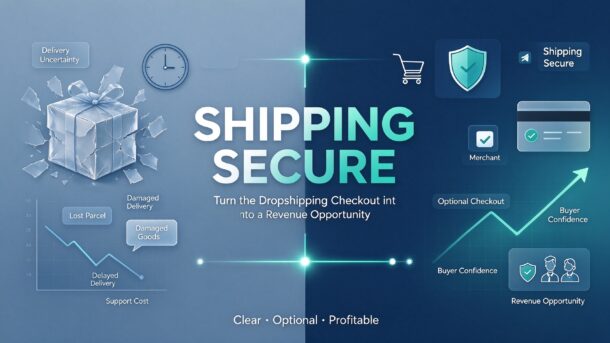
For dropshipping stores, rising acquisition costs and unpredictable delivery issues can quickly erode already-thin profit margins. But what if checkout could do more than collect payments? By combining shipping secure services with merchant-defined perks, online store owners can explore new revenue opportunities, address buyer concerns, and create more value from every order—without relying solely on higher product prices.
Shipping Is More Than a Fulfillment Cost
Many store owners focus on the same growth levers: finding winning products, lowering advertising costs, and increasing website traffic. Yet an important opportunity often sits at the final stage of the customer journey—the checkout.
A shopper may like a product, accept its price, and still hesitate before placing an order. Uncertainty about delivery times, lost packages, damaged goods, and the process of resolving a delivery problem can influence that final decision.
For dropshipping businesses, where merchants often depend on third-party suppliers and international shipping partners, these concerns deserve particular attention.
The question is no longer simply how to get more people to checkout. It is how to make checkout more useful to both the buyer and the business.
Why Delivery Uncertainty Matters for Dropshipping Stores
Dropshipping allows merchants to sell products without holding inventory themselves. That model reduces certain upfront costs, but it also means merchants may have less direct control over fulfillment.
A supplier may experience processing delays. A carrier may lose a parcel. A shipment may arrive damaged or later than expected. Even when the store owner did not cause the problem, the customer usually contacts the store—not the supplier or carrier—for a resolution.
These situations can create several costs:
- Customer support workload: Staff spend time investigating tracking updates, contacting suppliers, and responding to delivery complaints.
- Unexpected expenses: Replacements, reshipments, and refunds can reduce the margin earned on an order.
- Customer confidence: An unclear resolution process can damage the buyer’s perception of the store.
- Repeat-purchase potential: A frustrating delivery experience can make customers less willing to order again.
Shipping secure services can provide a clearer process for eligible delivery issues, such as lost, damaged, or delayed parcels, depending on the terms of the service. They should complement—not replace—accurate delivery estimates, reliable suppliers, and transparent shipping policies.
For store owners, the goal is to manage delivery uncertainty while making the buying experience more reassuring.
From an Extra Checkout Fee to a More Valuable Offer
The ecommerce industry has increasingly explored customer-paid checkout services as a way to address operational costs and create additional value.
In an August 2026 article, ecommerce platform Loop discussed how merchants can approach package-related costs and use optional checkout services to support their business models. Its reported performance figures are based on its own merchant ecosystem, so they should be understood as vendor-reported results rather than universal benchmarks.
The broader idea is worth considering: a checkout offer does not have to be limited to a single service.
Traditional shipping coverage focuses on delivery-related concerns. But merchants already have other ways to encourage customers to complete a purchase or return to the store, including free-shipping offers, discounts on future orders, loyalty incentives, and exclusive benefits.
Combining relevant services and merchant-defined perks into a clear, optional offer creates another approach to checkout design.
Instead of presenting buyers with unrelated add-ons, a store can build an offer around two questions:
- What would help the customer feel more confident about this purchase?
- What additional benefit would give the customer a reason to choose this store again?
The answers will differ by product category, order value, and customer expectations. The important point is to make the offer understandable, useful, and genuinely optional.
How Shipping Secure and Merchant Perks Can Work Together
A shipping secure offer addresses delivery-related concerns. Merchant-defined perks serve a different purpose: they give the store another way to add value to the purchase.
For example, a dropshipping store selling home accessories could offer an optional checkout package that includes eligible delivery-related services alongside a discount on a future purchase.
A fashion store might combine shipping-related benefits with a future-order voucher. A beauty store could offer an exclusive benefit designed to encourage a second purchase.
These offers serve two distinct functions:
Shipping-related services: Help customers understand what support is available if a covered delivery problem occurs.
Merchant-defined perks: Give customers additional reasons to purchase, return, or engage with the brand.
Keeping these functions distinct is important. Merchants should clearly explain which delivery events are covered by the shipping service and which benefits are provided directly by the store. A future-purchase discount, for example, should never be presented as though it covers a lost or damaged parcel.
Pricing also matters. An optional offer should display its total cost and benefits clearly before the customer accepts it. Merchants need to account for service fees, the cost of their own perks, expected redemption, and the potential effect on order profitability.
The objective is not to add more fees to checkout. It is to offer something customers can understand and choose for themselves.
Can Checkout Add-Ons Improve Dropshipping Profitability?
Adding an optional service does not automatically increase conversion rates or profit. Results depend on the offer, the audience, the price, and the store’s existing checkout experience.
Merchants should evaluate these offers using practical business metrics rather than relying on revenue figures alone.
Consider tracking:
- Opt-in rate: What percentage of eligible buyers choose the offer?
- Average order value: Does the offer change the total value of completed orders?
- Contribution margin: After product costs, advertising, fulfillment, service fees, and redeemed perks, does the order remain profitable?
- Checkout completion rate: Does the additional choice help or hinder the purchase process?
- Support workload: Are delivery-related questions and resolution times changing?
- Repeat purchases: Do merchant-defined perks encourage customers to return?
A simple comparison between eligible orders with and without the offer can provide an initial view of performance. Where possible, controlled testing can help distinguish the effect of the offer from changes in traffic quality, pricing, or promotions.
Dropshipping merchants should also avoid treating all orders alike. A low-priced accessory and a high-value electronic product may have very different delivery concerns and profit margins. The right offer should reflect those differences.
Where Gooval Fits Into This Approach
Gooval is built around the idea that checkout can offer more than a payment step. Its approach combines Shipping Secure services with merchant-defined perks, allowing independent ecommerce stores to present delivery-related benefits and additional customer incentives together.
The shipping service addresses eligible delivery events, including lost, damaged, and delayed parcels, subject to the applicable service terms. Merchants can also define additional perks, such as a future-purchase discount or free-shipping offer, to suit their business and customers.
The model also supports merchant-set markups, which merchants can retain, alongside revenue-sharing opportunities. This gives store owners another way to explore checkout revenue without depending exclusively on product-price increases.
For dropshipping merchants, the potential value is not simply adding another item to the checkout page. It is bringing delivery confidence and merchant-created value into a clearer, more coordinated offer.
As with any checkout add-on, the results depend on how well the offer fits the store, how clearly its terms are presented, and whether customers consider the additional value worth the price.
The Next Opportunity for Independent Ecommerce Stores
Dropshipping growth is often discussed in terms of product research, advertising, and supplier selection. Those areas remain important, but the checkout experience deserves equal attention.
When delivery uncertainty, support costs, and tight margins put pressure on a store, adding traffic alone may not solve the underlying problem. Merchants also need to consider how they communicate delivery expectations, manage service issues, and create value at the point of purchase.
Shipping secure services and merchant-defined perks offer one possible approach. Used thoughtfully, they can help stores address buyer concerns while exploring additional checkout revenue opportunities.
The principle is straightforward: make the offer clear, keep it optional, distinguish delivery services from merchant perks, and measure its effect on actual profitability.
For independent ecommerce stores looking to build a more resilient business, the checkout may be worth rethinking—not just as the place where a sale ends, but as another place where customer value begins.